
Thread lift before and after photos look different from filler or laser photos for one reason: a thread lift moves tissue mechanically, so the change in contour shows right away. Dissolvable threads with tiny barbs or cones are placed under the skin through small needle openings. They catch sagging tissue and lift it toward a firmer anchor point. Below are six real thread lift cases treated at Kondae PPEUM Clinic in Seoul, including two Mint thread cases. For each one we explain what the photos show and what they leave out. You will also find the answers our medical director, Dr. Park Hwonham, gives patients in consultation.
Thread lifting at a glance
- Good fit: usually from the 40s, with sagging of the jawline, cheeks or smile-line area. A doctor decides after seeing your face.
- Results: visible right after treatment, then settling naturally over a few weeks as swelling goes down
- How long: the threads dissolve in about 6–12 months. After a year or more it may feel a little lower again.
- Swelling: usually one to two weeks, so plan your flight and photos around it
- What matters most: the design and the doctor’s experience. Results vary a lot between doctors.
Thread Lift Before and After: 6 Real Cases in Seoul
All six patients were treated at Kondae PPEUM Clinic, which is directly connected to Konkuk Univ. Station Exit 1. Our records for these photos do not include the exact thread type, except where the photo title names it. They also do not record the number of threads, except where the title states it, or the time between the two photos, except in Case 5, where the image itself is labelled “immediately after.” For that reason we describe only what is visible.
Keep one thing in mind for all six cases. Photos taken soon after a thread lift can make the lift look stronger, because swelling adds fullness. The fairer comparison is a few weeks later, once the swelling has gone down.
The photos below are blurred for visitors. Create a free account to see every before and after photo at full resolution.
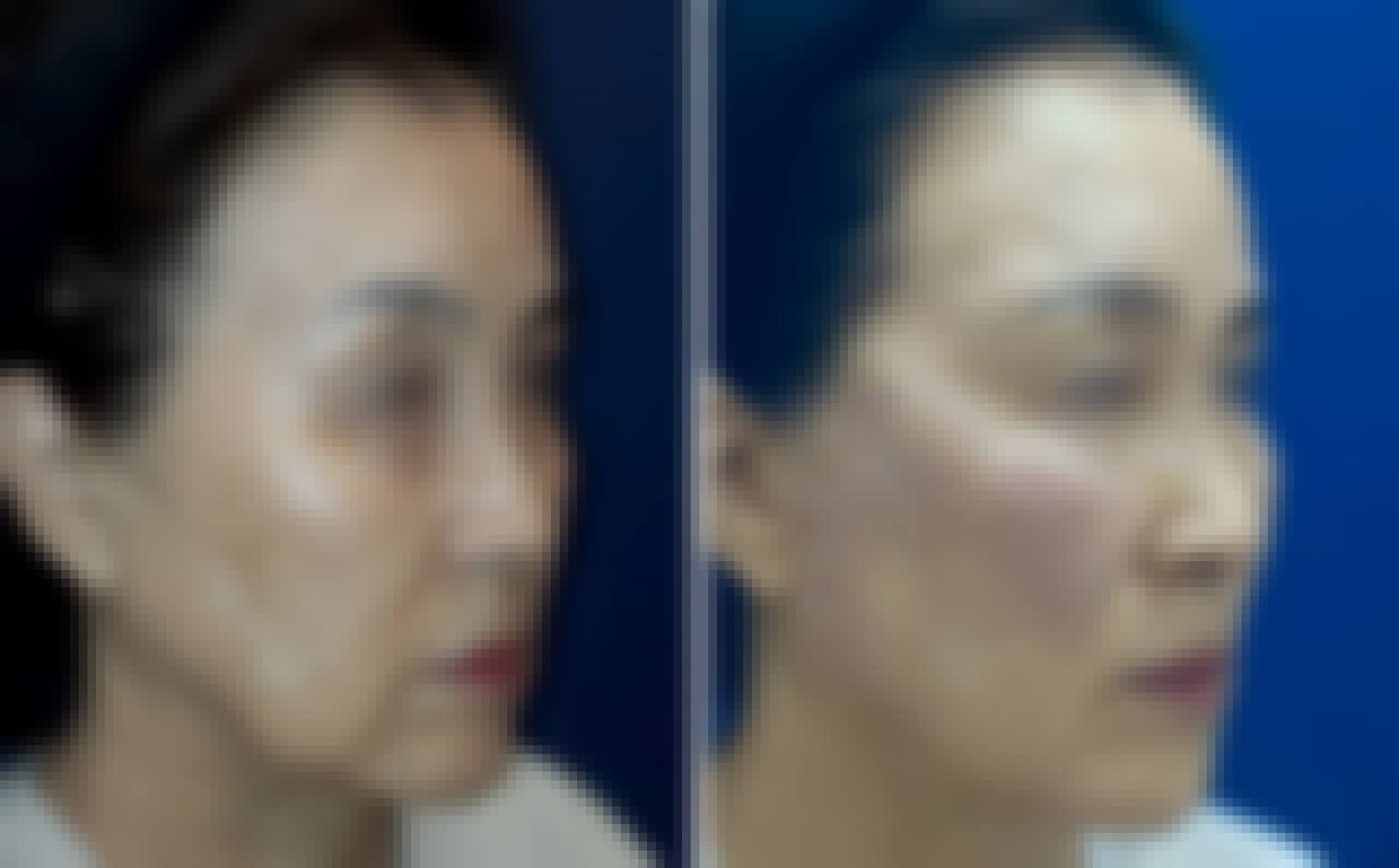
Case 1: Marionette lines and jowls (side view)
Want a change like this case?
Send us this case and Dr. Park's team will tell you whether a similar plan could suit you.
- Before: deep lines run down from the corners of the mouth. Fine creases sit around the lips, and the lower cheek hangs over the jawline as a jowl.
- After: the lines beside the mouth are shallower, the jowl is less visible, and the jawline from chin to ear reads as a cleaner line.
- Keep in mind: small round marks on the cheek and a red spot in front of the ear suggest the after photo was taken soon after treatment, when swelling can add to the effect. The before photo also has more shine, so compare contour rather than skin tone.
Case 2: Mint thread lift before and after — 16 threads
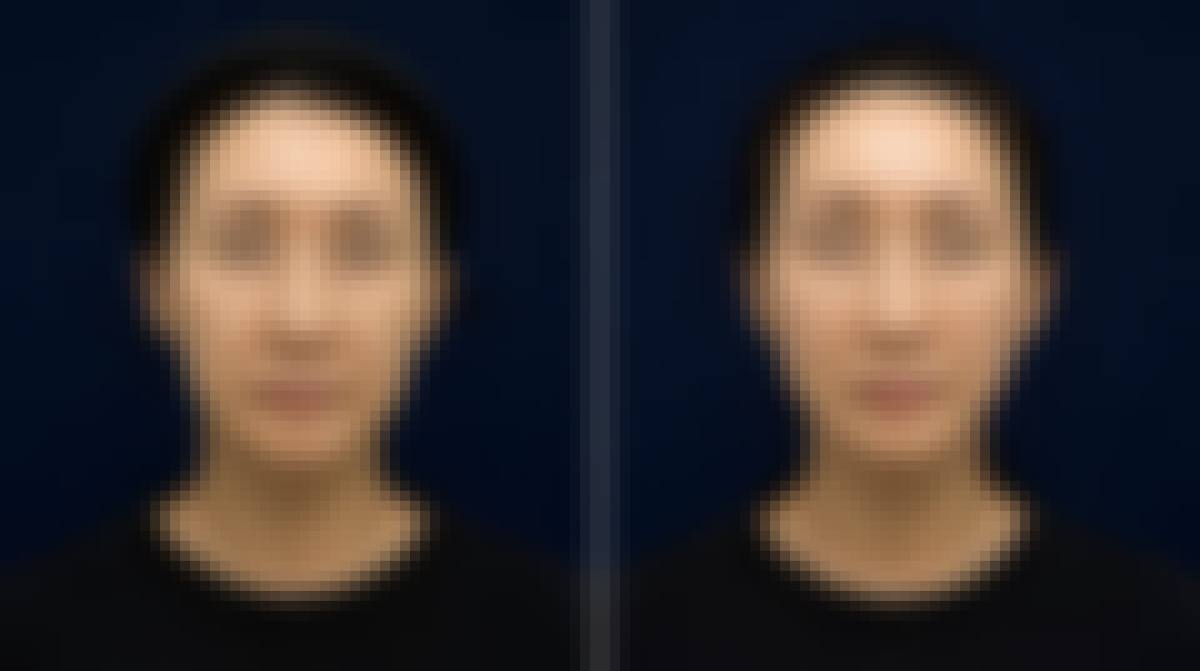
- Before: the lower cheeks are soft, with slight fullness above the jawline and shadows along the smile lines.
- After: the jawline looks more defined and the lower face looks neater and slightly narrower. The shadows beside the mouth are a little lighter.
- Keep in mind: the lighting and background are closely matched, but the headband is gone in the after photo. The change is subtle, which is typical when the goal is a natural contour.
Case 3: Juvederm + Mint thread lifting (combined treatment)
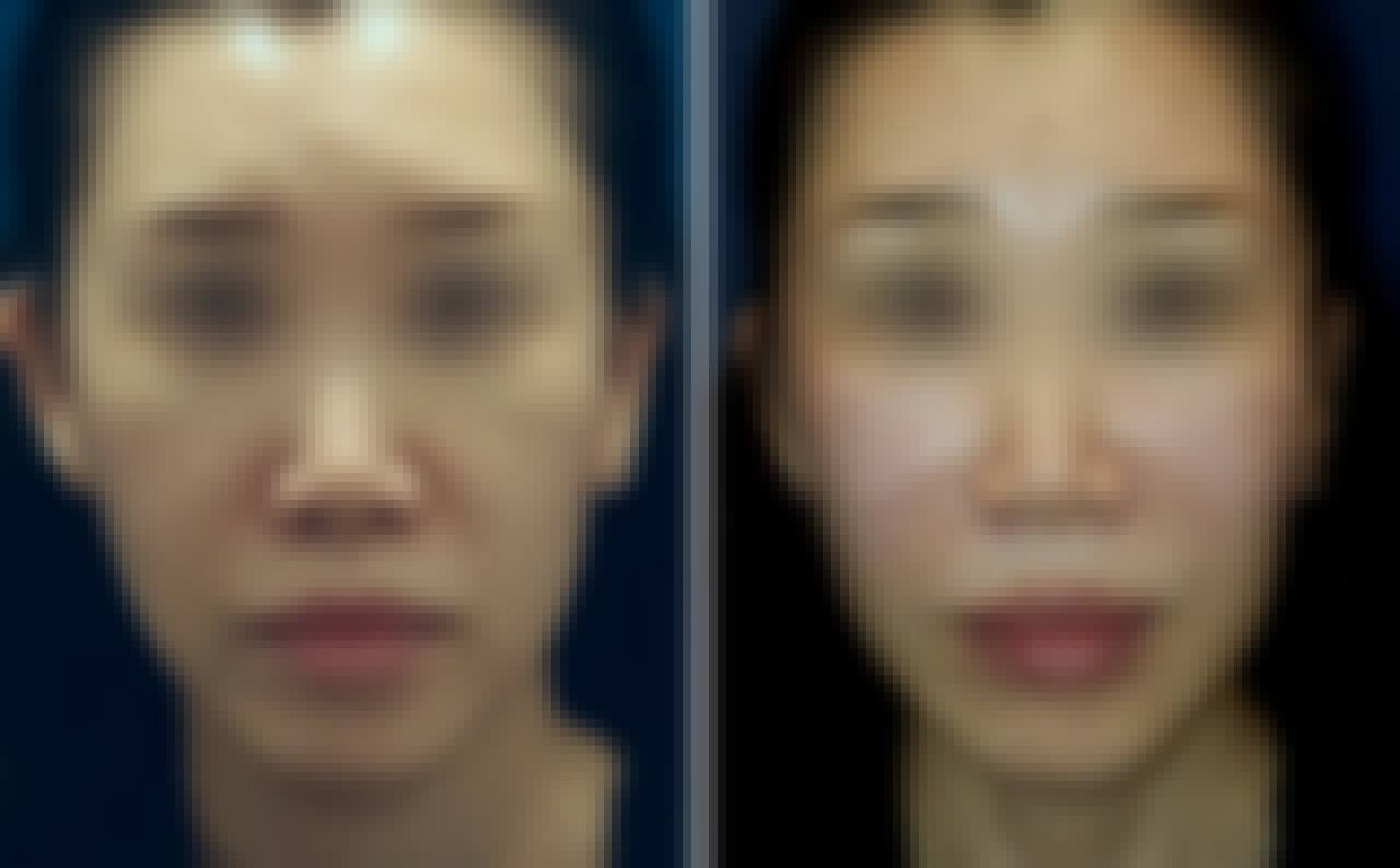
- Before: the mid-face looks flat, and the lower face looks heavy around the mouth.
- After: the cheeks look fuller and higher, the lips look fuller, and the area around the mouth looks less heavy.
- Keep in mind: this result reflects the combination of filler and threads. The cheek redness and different brow expression in the after photo also change how the face reads.
Case 4: Thread lifting with 12 threads (front view)
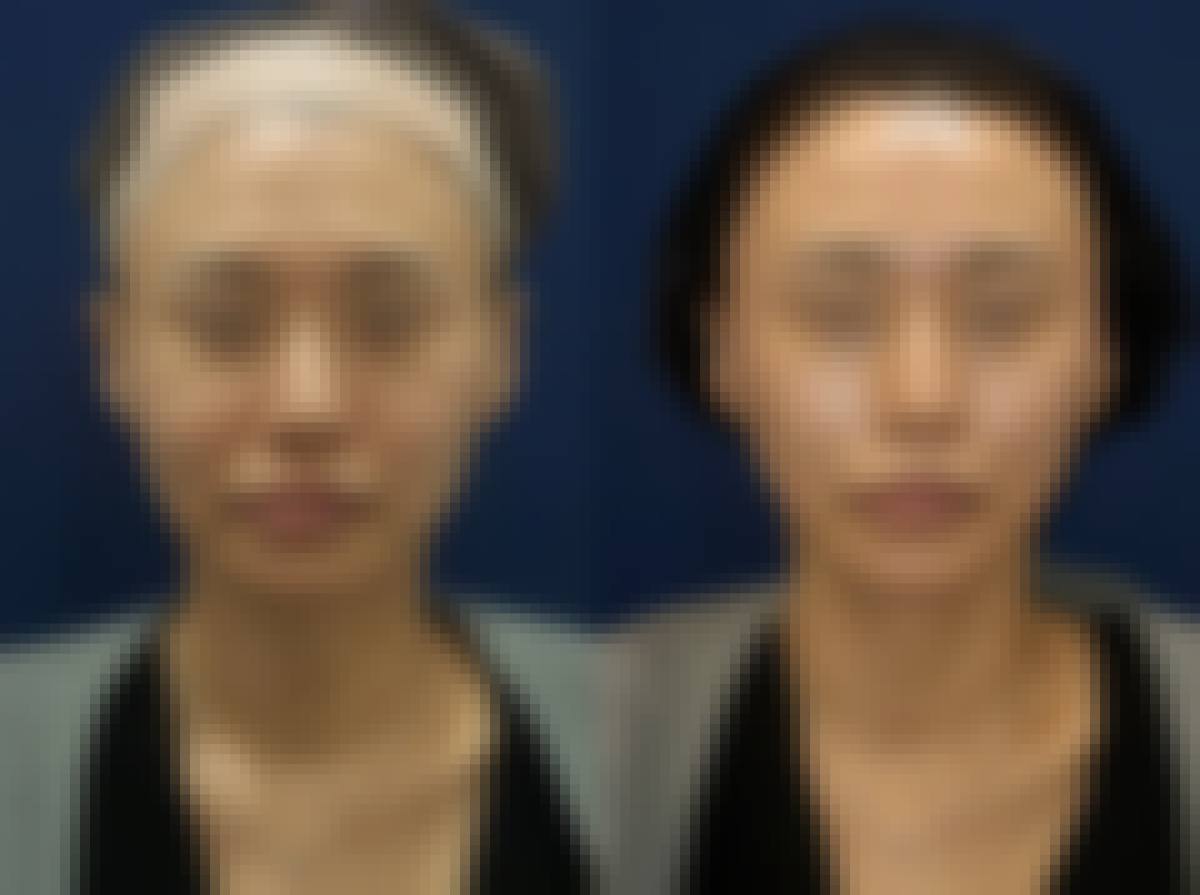
- Before: the lower face is wider at the jaw. Soft jowls sit beside the chin, and the jawline is blurred.
- After: the lower face tapers more toward the chin and the jawline looks tidier.
- Keep in mind: in the before photo the hair is covered by a clinic headband. In the after photo the hair is down and frames the face, and the lighting is brighter. Both can make a face look narrower.
Case 5: Lower face, immediately after a thread lift
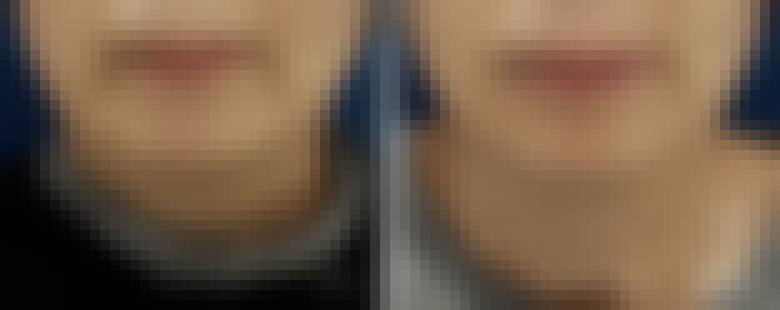
- Before: the corners of the mouth turn down, with lines running toward the chin and loose skin along the jaw and upper neck.
- After: the mouth corners look less heavy, the lines beside the chin are softer, and the jawline is smoother.
- Keep in mind: the image is labelled “immediately after,” so swelling is part of what you see. The clothing and color tone also differ between the two photos.
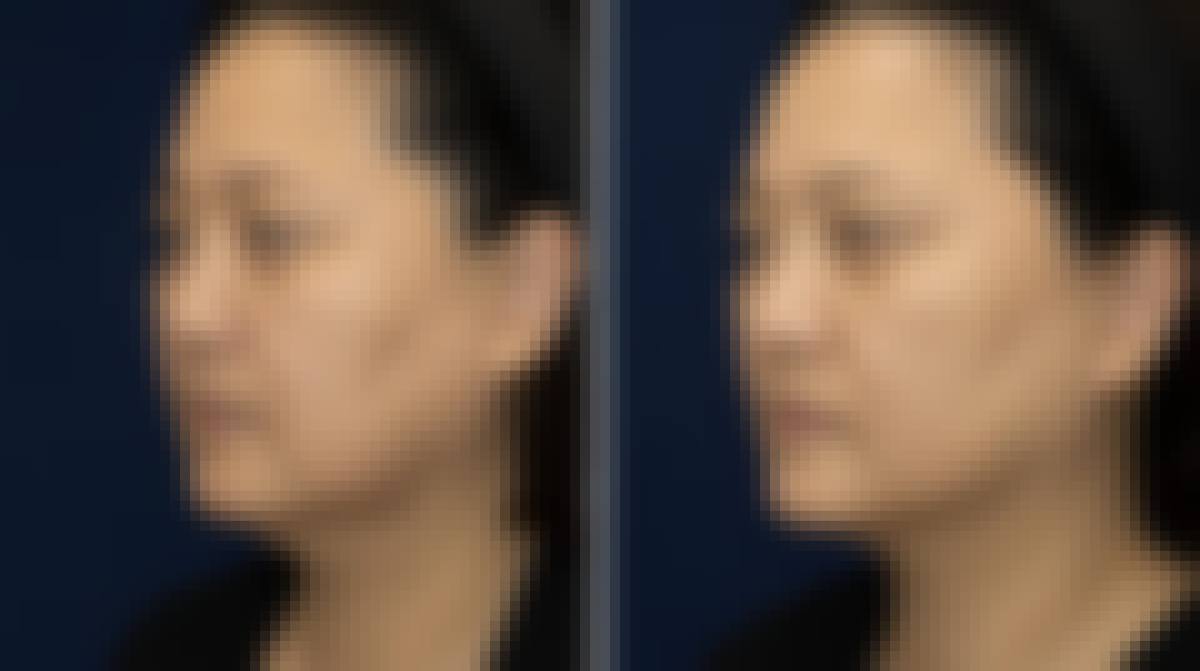
Case 6: Thread lifting + ONDA (jawline and under-chin)
Want a change like this case?
Send us this case and Dr. Park's team will tell you whether a similar plan could suit you.
- Before: the jowl breaks the jawline, the area under the chin is full, and the nasolabial fold is visible.
- After: the jawline runs more smoothly toward the ear, the under-chin area looks less full, and the jowl is less visible.
- Keep in mind: the angle and lighting are well matched here, but the result reflects the combination of threads and ONDA, not threads alone.
Our other thread cases each have their own article: marionette lines thread lift before and after and Mint 16 threads before and after. A free account is required to see the photos at full resolution.
 WhatsApp
 LINE
 KakaoTalk
DR.BAQUO’s Answers on Thread Lifts
These are the answers Dr. Park Hwonham (DR.BAQUO), Medical Director of Kondae PPEUM Clinic, gave in October 2026 to the questions patients ask most often about thread lifts. Dr. Park is a surgeon trained at Seoul National University Hospital.
Does a thread lift really work? What changes?
“A thread lift grew out of surgery. Surgeons use suture material to support tissue during a facelift, and a thread lift places that same material without an incision, to recreate part of that lifting effect as a procedure. Dissolvable threads with different kinds of barbs are hooked between a firm anchor point and the sagging tissue to be lifted. They go in as several lines through tiny needle openings. You can expect the jawline to look cleaner and the cheeks and smile-line area to sit higher from right after treatment. Because the face feels lifted straight away, satisfaction tends to be high. But it needs a design that suits your face and an experienced doctor, and there is some pain, so the bigger the change you want, the more carefully you should decide. At consultation, people have usually read about pain and swelling first and arrive worried, yet it is rare for someone to be unhappy afterward. That said, results vary a great deal with the skill of the doctor.”
How long does a thread lift last? Does it drop again when the threads dissolve?
“The lift looks strongest right after treatment and settles naturally a few weeks later, once the swelling goes down. The threads dissolve over months, but the collagen tissue that forms around them keeps part of the effect. After a year or more, you may feel things drop a little again. Keeping body fat and skin firmness under control in the meantime can make it feel longer-lasting. How long it lasts varies with the thread type and number, how much sagging there was, and your age. There are many variables, but threads are generally known to dissolve completely in about six months to a year, and the new tissue reaction as they dissolve keeps some tension. I tell patients to think of the result as lasting that long or longer.”
Am I a good candidate? Does it depend on age or how much sagging I have?
“An experienced doctor has to see your actual face and decide. The right thread depends not only on age and sagging but on many other factors, so make sure you have a proper consultation before treatment. I don’t think there is any need to recommend it at a very young age. I usually suggest it from the 40s onward, depending on the face.”
What is the difference between Mint threads and Silhouette Soft?
“Mint is a PDO thread with barbs, or cogs, that grips tissue tightly along its length and pulls it toward the anchor point. Silhouette Soft has cones and lifts tissue little by little from each cone. The pulling principle and the material are different, so they work differently and suit different cases. Even with the same thread, the result changes with how many threads go in and in which direction. Which product and how many threads to use is the doctor’s judgement for each face, so I think it is fine to use several different products rather than sticking to one.”
Which areas can be treated — smile lines, jawline?
“Anywhere with a clear direction of sag can be treated. That includes the smile-line area and front cheek, the lower cheek beside the mouth, the jawline, and the brow and forehead. A sagging double chin can also be supported with long threads placed like a hammock. Depth, direction and anchor point differ by area. In the front of the mid-face, where there are many expression muscles, we do not place threads in the shallow muscle layer.”
Does it hurt? How long is the swelling, and when can I fly home?
“Local anaesthetic is given where the threads go in, and sedation can be added if you prefer. Swelling and the tight feeling usually settle over one to two weeks, and bruising, if any, can last one to two weeks. For the first few weeks, avoid opening your mouth very wide or firm facial massage. You obviously need to eat, but the treated area can hurt when it is stimulated. For at least three to four days, be careful with food that needs a very wide mouth or long, hard chewing. Beyond that, normal common-sense care is enough.”
What about side effects — dimples, or threads poking out?
“Swelling, bruising and a tight feeling are common and mostly settle within a few weeks. Rarely, if a thread grips the layer too close to the skin, the surface can look slightly uneven, which is called dimpling. The thread can also be felt, or poke out at the entry point. If the opening then keeps failing to heal and the thread irritates the area, infection can occur, though very rarely. A thread that pokes out is simply found, then trimmed or removed. Dimpling should be caught early. We make a small opening nearby, find the thread and remove it. If it is mild, or removal isn’t possible, a little filler is placed in the dimple.”
Thread lift, Ultherapy or Onda — which one should I get?
“If you want a sagging line pulled up and the contour tidied immediately, choose a thread lift. If you want the skin and fascia tightened with heat for firmness, consider Ultherapy, Shurink, Onda or Thermage. They work differently, so they are often planned together, and I often recommend them together. Even after a thread lift, regular maintenance with a lifting device is what keeps the result for longer. So I suggest both, for the synergy and for maintenance.”
Why do prices differ between clinics, and what should I compare?
“Some clinics price by thread type and number. Others use several threads as the doctor sees fit and price the procedure as a whole. I don’t recommend paying a very high price for a thread lift. Most people find their doctor through recommendations from people they know.”
How Korean Thread Lifting Works
A thread lift developed from facelift surgery. The same kind of suture that supports tissue during surgery is placed through tiny needle openings, with no incision. In Korea, PDO barbed threads such as Mint are the most common choice. Common dissolvable materials are PDO (polydioxanone), PLLA (poly-L-lactic acid) and PCL (polycaprolactone). Each one dissolves at a different speed. The process has three stages:
- Anchor and lift: the thread goes into the subcutaneous fat layer through a tiny needle opening. It is hooked between a firm anchor point above and the sagging tissue to be lifted. Its barbs or cones grip the surrounding tissue, so when the thread is drawn up and fixed, the sagging tissue moves with it.
- Collagen: the body treats the thread as foreign and builds a thin fibrous layer around it. In an animal study of barbed PDO threads in guinea pig skin, a fibrous capsule formed around the thread. Type I collagen and TGF-β1 stayed higher than in normal skin throughout the seven-month study.
- Dissolving: the thread usually dissolves over six months to a year, and the tissue reaction it leaves behind keeps some of the tension.
This is also why thread lift photos differ from heat-based lifting photos. Ultherapy or Thermage tighten tissue with heat over weeks to months, while a thread lift changes the contour on the day.
How Long Does a Thread Lift Last?
| Time | What usually happens |
|---|---|
| Right after | The lifted contour is visible at once, and swelling can make it look higher at first |
| A few weeks | Swelling settles and the result looks natural |
| 6–12 months | The threads dissolve while the collagen tissue around them supports the area |
| After a year or more | It may feel a little lower again. How long it lasts varies with thread type and number, how much sagging there was, and age. |
Two things help the result hold for longer: keeping body fat and skin firmness in check, and regular maintenance with a lifting device. Research also asks for realistic expectations. In a meta-analysis of 26 studies, satisfaction fell from 98% right after treatment to 88% at long-term follow-up, so results may not last unchanged. A 2025 review of 12 studies on dissolvable threads (818 people, 2018–2022) found improvement right after treatment in every study and only mild complications. However, the longest follow-up was two years.
 Before
 Months later
Who Is a Good Candidate?
Whether threads suit you is something an experienced doctor should decide by seeing your face. Age and sagging matter, but so do skin thickness, fat and the direction of sag, and these change which thread is recommended. If you are booking from abroad, send clear front and side photos first, then confirm at the in-person consultation.
| Usually a good fit | Threads have limits |
|---|---|
| A clear direction of sag, such as jowls or smile lines | Heavy sagging with loose skin |
| You want a quick contour change without surgery | Very thin skin where threads may show |
| You plan regular maintenance with a lifting device | Little sagging yet, at a young age |
Thread Lift, Korean Style: Mint Thread Lifting vs Silhouette Soft
| Type | What it looks like | What it does |
|---|---|---|
| Barbed (cog) PDO thread, e.g. Mint | Tiny barbs along the thread | Grips tissue tightly along its length and pulls it toward the anchor point |
| Cone thread, e.g. Silhouette Soft | Dissolvable cones at intervals (PLLA·PLGA) | Lifts tissue little by little from each cone |
| Smooth (mono) thread | No barbs | Works on collagen and skin texture rather than lifting |
Mint thread lifting uses barbed PDO threads, the type shown in Cases 2 and 3 above. Mint and Silhouette Soft differ in pulling principle and material, so they suit different cases. Results depend on more than the brand. How many threads go in, in which direction and at what depth, and where they are anchored all matter just as much, and that is the doctor's call for each face.
Which Areas Can Be Treated?
| Area | Common concern |
|---|---|
| Smile-line area, front cheek | Nasolabial folds, cheek sagging |
| Lower cheek beside the mouth | Sagging that makes the mouth corners look heavy (see Cases 1 and 5) |
| Jawline | Jowls, a blurred jaw contour |
| Double chin | Sagging under the chin, supported by long threads placed like a hammock |
| Brow, forehead | Drooping brows, heavy-looking eyelids |
Depth, direction and anchor point differ by area. In the front of the mid-face, where expression muscles are dense, threads are not placed in the shallow muscle layer. If a deep fold also needs volume, filler can be planned alongside the threads, as in Case 3 (see nasolabial fold filler before and after).
Pain, Swelling and Downtime for Thread Lifting in Korea
Local anaesthetic is given at the entry points, and sedation can be added. There is some pain, so decide on anaesthesia at the consultation.
| Reaction | Usually lasts |
|---|---|
| Swelling, tight feeling | One to two weeks |
| Bruising, if any | One to two weeks |
| Stiffness when opening the mouth wide | A few days to a few weeks |
Eat normally, but for at least three to four days go easy on food that needs a very wide mouth or long, hard chewing. For the first few weeks, avoid opening your mouth very wide and avoid firm facial massage, because tissue that moves before the threads settle can weaken the hold. If you are flying home, leave a few days between treatment and departure so the clinic can check you once. Also remember that photos taken in the first one to two weeks show swelling, as in Case 5.
Side Effects
The meta-analysis of 26 studies reported the following rates:
| Reaction | Reported rate |
|---|---|
| Swelling | 35% |
| Skin dimpling | 10% |
| Altered sensation | 6% |
| Visible or palpable thread | 4% |
| Infection | 2% |
| Thread extrusion | 2% |
In the same analysis, dissolvable threads caused less altered sensation and extrusion than permanent threads, and people over 50 had more dimpling and infection. Another review found that most reactions settled on their own. However, contour irregularities, infection and inflammatory reactions sometimes needed treatment. Dimpling and extrusion mostly happen when a thread grips the layer too close to the skin.
- Thread pokes out: the clinic finds the thread, then trims or removes it.
- Dimpling: if caught early, the thread is removed through a small opening nearby. If the dimple is mild or removal isn't possible, a little filler is placed.
- Entry point won't heal: it should be checked promptly, since an irritating thread can rarely lead to infection. If dimpling, pain or warmth persists, even after you are home, contact the clinic right away.
- Tell the clinic first if you are pregnant or breastfeeding, take blood thinners, form keloids easily, have inflammation or a skin condition in the area, or recently had filler there.
Thread Lift vs Ultherapy, Shurink, ONDA and Thermage
| Thread lift | Ultherapy · Shurink | ONDA · Thermage | |
|---|---|---|---|
| How | Threads catch and lift tissue | Focused ultrasound heat tightens | Microwave or RF heats broadly |
| Change shows | Right away | Over weeks to months | Over weeks to months |
| Best suited to | Moving a sagging contour upward | Fascia, firmness, jawline | Skin firmness, fat layer |
It is rarely one or the other, and they are often planned together, as in Case 6 (threads + ONDA). The threads lift the contour first, and regular maintenance with a lifting device helps the result last longer. For heat-based options, see our HIFU before and after (Shurink case) and a patient's ONDA lifting face treatment story.
Korean Thread Lift Cost: What to Compare
Clinics don't even price thread lifts the same way. Some charge by thread type and number. Others use several threads as the doctor sees fit and price the procedure as a whole. Kondae PPEUM Clinic's published standing price for a Mint thread is KRW 120,000 per single line. The forehead lifting thread (8 lines) is KRW 790,000. Prices are subject to change, and current details are on global.drbaquo.com.
Thread lift events in Korea
Kondae PPEUM Clinic regularly updates its events and packages, including first-visit prices and bundles with other treatments. The prices above are standing prices. For the latest Thread lift event prices and conditions, check the packages page.
See current events →The total depends on how many lines your face needs, which is decided at consultation. To compare clinics fairly, check these points on the same basis:
- Which thread and how many, or a per-procedure price
- Full face or specific areas
- Anaesthesia: local only, or with sedation
- Whether follow-up visits and aftercare are included
Because the result depends so much on the doctor's experience, look at who performs the procedure rather than price alone.
FAQ — Thread Lift Before and After in Korea
Q: Do the threads stay in my face?
A: No. Dissolvable threads usually break down in the body over six months to a year. The speed depends on the material (PDO, PLLA or PCL), so ask which thread will be used.
Q: Will my face drop back once the threads dissolve?
A: The collagen tissue formed around the threads keeps some tension. After a year or more it may feel a little lower again. Managing body fat and skin firmness, and maintaining with a lifting device, help it last longer.
Q: What do mint thread lift reviews usually say?
A: Dr. Park finds that patients often arrive worried about pain and swelling, yet it is rare for someone to be unhappy afterward. He adds that results vary a great deal with the doctor's skill. Research on thread lifts in general found satisfaction of 98% right after treatment and 88% at long-term follow-up, so read reviews with that in mind. Reviews posted right after treatment also reflect swelling.
Q: Do you list a nose thread lift Korea price?
A: No. The director-reviewed guide behind this article covers threads for the cheeks, smile-line area, jawline, double chin, brow and forehead, but not the nose. For that reason we don't quote a nose thread lift price here. Our published thread prices are the Mint single line and the forehead lifting thread (8 lines) shown above. Ask about the nose at consultation.
Q: Can I get filler or Botox on the same day?
A: They are often planned together, as in Case 3 (Juvederm + Mint threads). If the areas overlap, the order and interval may change, so plan them at the consultation.
Q: Is a thread lift the same as a facelift?
A: No. A surgical facelift removes and repositions skin and deeper tissue. A thread lift lifts with threads placed through tiny entry points. It suits earlier sagging and does not last as long as surgery.
Q: How do I see the full-resolution before and after photos?
A: Create a free DR.BAQUO account. Members can view every case in this post without blur.

Related Before & After Cases and Guides
- Hollow Temples Treatment in Korea: Gouri & HILO WAVE Before and After
- Skin Booster Before and After Korea — Gouri + HILO WAVE Results
- Lip Filler Before and After Seoul — DR.BAQUO Results
- Cheek Filler Korea: Get Natural Volume in One Day
- Double Chin Treatment Korea: Seoul's Most Effective Fix
- Before & After gallery (members)
Sources
- Niu Z et al. A Meta-Analysis and Systematic Review of the Incidences of Complications Following Facial Thread-Lifting. Aesthetic Plast Surg, 2021. PubMed 33821308
- Riopelle AM et al. Update on Absorbable Facial Thread Lifts. Dermatol Surg, 2025. PubMed 39662017
- Pham CT et al. Safety Profile of Thread Lifts on the Face and Neck — An Evidence-Based Systematic Review. Dermatol Surg, 2021. PubMed 34699439
- Kim J et al. Investigation on the Cutaneous Change Induced by Face-Lifting Monodirectional Barbed Polydioxanone Thread. Dermatol Surg, 2017. PubMed 27748691
- Goldberg DJ. Stimulation of collagenesis by poly-L-lactic acid (PLLA) and -glycolide polymer (PLGA)-containing absorbable suspension suture. J Cosmet Dermatol, 2020. PubMed 32167231
Photos are real Kondae PPEUM Clinic patients shown with eyes blurred where the eyes are visible. Results vary between individuals and one case does not predict another. Doctor's answers: Dr. Park Hwonham (DR.BAQUO), Medical Director, Kondae PPEUM Clinic, October 2026.
DR.BAQUO | Hanlim Tower 2F, 229 Achasan-ro, Gwangjin-gu, Seoul | Konkuk University Station Exit 1 (Line 2) | Google Maps | LINE: @364kbfyj | global.drbaquo.com
VISIT
Kondae PPEUM Clinic
Dr. Park Hwonham (DR.BAQUO), Medical Director
- Address
- Hanlim Tower 2F, 229 Achasan-ro, Gwangjin-gu, Seoul
- Subway
- Line 2 Konkuk Univ. Station Exit 1 (directly connected)
- Hours
- Mon–Fri 10:00–20:30 · Sat 10:00–16:30 (KST)
 WhatsApp
 LINE

 WhatsApp
 LINE
 WeChat
 Instagram
 YouTube
 TikTok
 KakaoTalk

