
Marionette lines — those vertical creases that run from the corners of the mouth down toward the chin — are one of the most common concerns patients bring to DR.BAQUO. They can make the face appear stern, tired, or significantly older than a person actually feels. Marionette lines thread lift treatment has emerged as one of the most sought-after non-surgical approaches to address this specific area of facial aging, and the before and after photographs we share in this post capture exactly why patients fly to Seoul from across Asia and beyond to seek this procedure.
At DR.BAQUO, we approach thread lifting for marionette lines with a focus on natural results — not an artificially pulled look, but a genuine restoration of the lower face’s youthful contour. In this post, we walk through the real case shown in our clinic’s image record, explain the clinical reasoning behind the treatment, and give you the honest information you need to decide whether this approach is right for you.
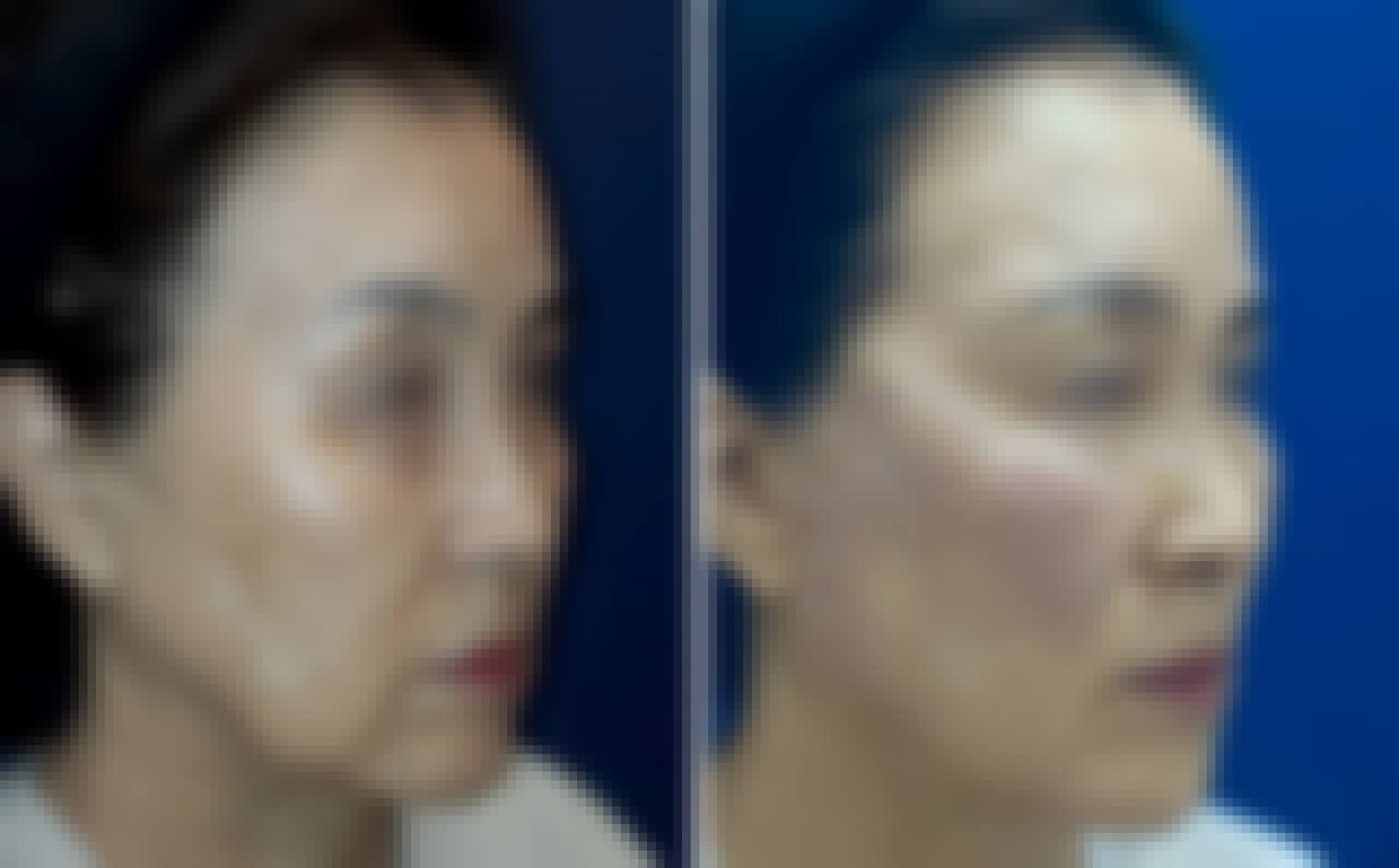
Quick answer: The before and after photograph from this case shows a visible reduction in the depth of the marionette line groove on the lower face, with improved definition at the jawline and a lifting of the tissue that had been descending toward the chin. The image was captured under standard clinical lighting with the patient in a consistent frontal position. Please note that individual outcomes vary significantly based on skin quality, tissue laxity, and anatomical structure — the result shown reflects one specific patient’s response and cannot be taken as a guarantee of the same outcome for any other individual.
What Are Marionette Lines and How Does Thread Lifting Work?
Marionette lines are deep vertical grooves that form between the mouth corners and the lower jaw, named for the hinged mouths of marionette puppets. They are a direct consequence of facial soft tissue descent — as the mid-face loses volume and the skin’s structural support weakens with age, tissue that once sat higher on the face gradually falls downward, pooling above the jawline and creasing the skin along predictable anatomical pathways. Genetics, sun exposure, repeated facial movement, and gravitational force all contribute to their formation.
Thread lifting for marionette lines works by introducing absorbable lifting threads into the subcutaneous layer of the lower face. These threads, once placed along a planned vector, grip the soft tissue and mechanically reposition it toward its original, higher location. This produces the immediate lifting effect visible in before and after photographs. Beyond the mechanical lift, absorbable threads are known to stimulate the body’s own collagen production around the thread material over the weeks and months following treatment. This secondary biological response is why many patients continue to notice gradual improvement even after the immediate result has settled.
Why the Lower Face Presents Unique Challenges
The anatomy of the lower face makes marionette line treatment technically demanding. The marginal mandibular nerve and facial artery run in close proximity to the treatment zone, and the weight of descending tissue from the mid-face exerts downward pressure that a thread lift must counteract effectively. Thread placement angle, entry point selection, and depth of insertion all determine whether the final result looks natural or distorted.
The Mechanism Behind Visible Before and After Differences
The before and after change in a thread lift case reflects two overlapping processes: the mechanical repositioning of descended tissue (visible almost immediately) and the progressive collagen remodeling that reinforces that position over time. Patients typically notice the first change on the same day as treatment once swelling subsides, with continued refinement over the following weeks as inflammation resolves and new collagen matures. The source record for this case does not specify the thread brand, thread count, or the interval between the before photograph and the after photograph, so specific timelines cannot be attributed to this individual case.
Approval Status and Safety Profile
DR.BAQUO uses only MFDS-certified equipment and materials, with certification records displayed visibly in the clinic. For balanced risk information, please refer to the peer-reviewed literature listed in our Sources section at the end of this post, which documents both the efficacy and the known complication profile of facial thread lifting procedures.
 WhatsApp
 LINE
 KakaoTalk
Marionette Lines Thread Lift Before and After — Case Analysis
The image record provided for this post documents a single case of thread lifting for marionette lines performed at DR.BAQUO. The source record confirms the treatment type as thread lifting for marionette lines. It does not record the thread brand, number of threads used, the patient’s age, the time elapsed between photographs, or any combination treatments. All analysis below is drawn exclusively from what is visible in the supplied photograph.
What the Before Image Shows
In the before photograph, the marionette line groove is clearly visible as a downward-running shadow from the right and left mouth corners toward the lower jaw. The soft tissue lateral to the line appears to have descended, creating a slight heaviness or fullness below the corner of the mouth that emphasizes the crease. The oral commissure — the corner of the mouth itself — appears to point slightly downward in its resting position, which is a characteristic feature when the surrounding tissue lacks adequate support. The jawline contour shows early irregularity in the jowl zone just lateral to the chin, which is consistent with the tissue descent pattern that typically accompanies marionette line formation.
What the After Image Shows
In the after photograph, captured under clinically consistent frontal lighting, the following changes are observable in the lower face:
- The depth of the marionette groove appears reduced, with less shadow accumulation along the crease line
- The soft tissue lateral to the mouth corners appears slightly more elevated, reducing the downward-pointing appearance of the commissure
- The jawline contour in the jowl zone shows improved definition, with a smoother transition between the lower cheek and the jaw
- Overall lower face proportion appears refreshed, with less visual weight pulling the face downward
Important Limitations of Photograph-Based Analysis
Several variables deserve acknowledgment before interpreting these results:
- The before and after photographs appear to be taken under broadly similar lighting and at a similar angle and distance, which supports meaningful comparison — however, minor differences in expression, muscle tension, or head tilt between the two shots can influence the apparent depth of a crease
- The source record does not specify when the after photograph was taken relative to treatment, meaning we cannot determine whether the image captures the immediate post-swelling result or a longer-term outcome
- Individual results vary. The improvement visible here reflects this patient’s specific tissue quality, anatomy, and response to treatment
For additional real patient cases from DR.BAQUO, including thread lift cases with documented thread counts and clinical notes, visit our Before and After gallery.
What Makes These Marionette Line Thread Lift Results Possible
Results like those shown in this marionette lines thread lift before and after case do not happen by accident. They are the product of precise anatomical planning, technically exact thread placement, and a clinical philosophy that prioritizes proportion and naturalness over aggressive correction.
Dr. Park’s Personal Approach to Every Procedure
At DR.BAQUO, Dr. Park performs both consultation and treatment personally — every injection, every thread placement is the doctor’s own hand. This is not the norm in every aesthetic clinic, where injections or thread procedures may be delegated to nurses or assistants after the physician has completed the consultation. In the context of marionette line thread lifting, where the marginal mandibular nerve and facial vasculature lie in proximity to the treatment zone, physician-level precision at the point of needle and cannula entry is not a luxury — it is a clinical necessity. Patients at DR.BAQUO receive the same physician attention from the moment they sit in the consultation chair to the last thread placement of the procedure.
Thread Vector Planning for the Lower Face
The most critical technical variable in marionette line thread lifting is vector selection — the direction in which the thread lifts the tissue. An incorrectly planned vector can create puckering, dimpling, or an unnatural lateral pull that looks operated-upon rather than refreshed. At DR.BAQUO, the lift vector for each patient is planned individually based on their facial proportions, tissue laxity pattern, and the specific anatomy of their marionette line. The goal is to restore tissue to where it once sat naturally, not to pull it to where it has never been.
Combination Approaches That Enhance Outcomes
Thread lifting addresses tissue position — it repositions what has fallen. It does not directly replace volume that has been lost or improve skin texture at the surface level. For many patients with marionette lines, a combination approach that includes thread lifting alongside carefully placed filler can produce a more comprehensive result than either treatment alone. If you are curious about how filler and thread lifting can be used together for the lower face, our Nasolabial Fold Filler Korea case analysis and our DR.BAQUO Filler page offer useful context. Combination planning is always discussed individually during consultation and is never applied as a one-size-fits-all protocol.
Why Results Vary Between Patients
The same thread count placed by the same physician will produce different visible outcomes in different patients because marionette line depth, skin thickness, subcutaneous fat volume, and soft tissue laxity differ substantially from person to person. A patient with thinner skin and moderate tissue laxity will respond differently from a patient with thicker, more fibrotic tissue. This is why the clinical photograph shown in this post represents one specific patient’s outcome and should not be taken as predictive of your own.
Recovery and What to Expect After Thread Lifting for Marionette Lines
Understanding the recovery process is essential for planning your treatment, particularly if you are visiting Seoul from abroad. The following information represents general guidance based on the nature of thread lifting procedures — it is not a description of this specific patient’s recovery, as the source record does not include recovery timeline data.
Immediately After Treatment
Immediately following thread lifting, most patients experience mild swelling, redness at the entry points, and a sensation of tightness or pulling in the treated area. Minor bruising at needle or cannula insertion sites is possible, particularly in the lower face where tissue vascularity is variable. The treated area may feel tender to the touch.
The First Week — General Guidance
As general guidance applicable to thread lifting procedures, the first week typically involves gradual resolution of initial swelling and bruising. Patients are generally advised to avoid vigorous facial massage, extreme facial expressions, dental procedures that require wide mouth opening, and high-heat environments such as saunas during the early recovery period. Sleeping with the head slightly elevated can help manage initial swelling. These are general recommendations — your physician will provide specific aftercare instructions based on your individual procedure.
Week Two Through Month Three — Progressive Improvement
As general guidance, thread lifting patients often notice the initially swollen or slightly stiff feeling resolve during the second and third weeks, at which point a more natural-looking result becomes apparent. Over the following months, the collagen-stimulating effect of the absorbable thread material contributes to continued improvement in tissue firmness and contour. Many thread lift patients describe their best-looking result appearing somewhere between one and three months after treatment as new collagen matures — this is general guidance, not a claim specific to this case or this patient.
Practical Considerations for International Patients
DR.BAQUO is located directly at Konkuk University Station Exit 1 on Seoul Subway Line 2, making it easily accessible for international patients arriving from Incheon Airport or staying anywhere along the subway network. Our multilingual staff — fluent in Chinese, Japanese, and English — are available throughout your visit to ensure clear communication about your recovery instructions. For patients returning home before their follow-up window, post-treatment follow-up is available via LINE at @364kbfyj, allowing Dr. Park to review photographs and answer questions remotely.
Who Is a Good Candidate for Marionette Lines Thread Lift Treatment?
Marionette lines thread lift treatment tends to produce the most noticeable improvements in a specific type of patient profile. Understanding whether you fit that profile — and when an alternative approach might serve you better — is part of what DR.BAQUO’s consultation process is designed to determine.
The Ideal Candidate Profile
Patients who typically benefit most from thread lifting for marionette lines share several characteristics:
- Mild to moderate tissue laxity in the lower face, where descended tissue has enough structural integrity to be lifted and held
- Marionette lines that are primarily caused by tissue descent rather than primarily by deep volume loss
- Realistic expectations about the degree of improvement — thread lifting is a repositioning treatment, not a surgical facelift
- Good general health without conditions that significantly impair wound healing or collagen formation
- Skin that retains reasonable elasticity — extremely lax or heavily sun-damaged skin may not respond as predictably
When to Consider Alternatives or Complementary Treatments
Some patients present with marionette lines that are predominantly driven by volume loss rather than tissue descent. In these cases, filler placed precisely along the marionette groove or in the prejowl sulcus may address the visible crease more directly than thread lifting alone. Others have such significant tissue laxity that non-surgical approaches offer only limited improvement, and a surgical consultation may be appropriate.
For patients considering thread lifting in a broader lower face context — including concerns about nasolabial folds or overall jawline definition — our DR.BAQUO Thread Lift page provides an overview of how thread lifting is used across multiple zones of the face, and our Thread Lift Korea Before and After (Mint 16 threads) post shows a documented multi-thread case with detailed clinical notes for comparison.
Considerations for Patients Visiting from Abroad
For patients traveling from Japan, China, Taiwan, Hong Kong, or other countries to receive marionette lines treatment in Korea, planning the timing of your Seoul visit is important. General guidance suggests allowing several days of local time after treatment before long-haul flights, to permit initial swelling resolution and to allow for an in-person follow-up before departure. Please discuss your travel schedule honestly during consultation so that Dr. Park can factor your return timeline into the treatment plan.
Our Signature Program is specifically designed for international patients who wish to combine multiple treatments during a single Seoul visit, with scheduling structured around your travel dates.

FAQ — Marionette Lines Thread Lift Before and After Questions
Q: What do marionette lines thread lift before and after photos actually show?
A: Authentic before and after photographs for this treatment typically show a reduction in the visible depth of the marionette groove, a slight upward repositioning of the tissue at the mouth corners, and improved lower face contour. The improvement reflects mechanical tissue repositioning by the threads. What photographs cannot show is whether the result is due to thread lift alone, combination treatment, or photographic variables such as lighting, expression, or timing of the shot. At DR.BAQUO, we document cases under standardized clinical conditions to minimize these variables and present results as accurately as possible.
Q: How long do marionette line thread lift results last?
A: The source record for the case shown in this post does not specify result duration. As general guidance, the longevity of thread lift outcomes depends on thread material, thread count, patient age, skin quality, and lifestyle factors. Absorbable threads are gradually metabolized by the body, and the structural support they provide diminishes over time. Many patients choose to repeat the treatment periodically to maintain their result. Your physician will give you a realistic expectation during consultation based on your specific anatomy.
Q: How much does it cost to get rid of marionette lines with thread lifting in Korea?
A: The source record does not include a price for this case, and DR.BAQUO does not publish a single fixed price for marionette line thread lifting because the cost depends on several variables: the number of threads required based on your individual anatomy, whether combination treatment is recommended, and the specific thread type selected for your case. Rather than presenting a number that may not reflect your actual quote, we recommend booking a consultation — either in person at the clinic or via LINE at @364kbfyj — where Dr. Park can assess your lower face and give you an accurate, personalized treatment plan with transparent pricing.
Q: Is thread lifting better than filler for marionette lines?
A: Thread lifting and filler address marionette lines through different mechanisms, and the “better” choice depends on the underlying cause of the lines in your specific case. Thread lifting repositions descended tissue; filler replaces lost volume or directly fills a groove. Many patients benefit from a thoughtfully combined approach. During consultation at DR.BAQUO, Dr. Park evaluates whether the primary driver of your marionette lines is tissue descent, volume loss, or both, and recommends accordingly. You can also explore our Nasolabial Fold Filler Korea post to understand how filler approaches to adjacent lower face concerns work.
Q: What are the risks of thread lifting for marionette lines?
A: Peer-reviewed literature documents a range of potential complications from facial thread lifting, including bruising, swelling, infection, thread visibility or palpability under the skin, asymmetry, dimpling, and — in rarer cases — nerve injury or vascular complications. A systematic review of facial thread-lifting complications (cited in our Sources section below) provides a comprehensive overview of reported adverse events. The risk profile varies with technique, thread type, patient anatomy, and physician experience. DR.BAQUO uses only MFDS-certified materials, and Dr. Park discusses individualized risk in detail during every consultation.
Q: How many threads are needed for marionette line treatment?
A: The source record for this case does not specify the number of threads used. Thread count varies significantly between patients depending on the depth and extent of the marionette lines, the degree of tissue laxity, and whether other areas of the lower face are being addressed simultaneously. There is no universal correct number. Clinics that publish a fixed thread count without examining the patient are quoting a protocol, not a personalized plan. At DR.BAQUO, thread count is determined by Dr. Park during physical consultation and is tailored to each patient’s anatomy.
Q: Can marionette lines be completely eliminated with thread lifting?
A: Thread lifting can produce meaningful visible improvement in marionette lines, as seen in the before and after photograph from this case, but “complete elimination” is not a realistic expectation for most patients. Deep, long-established marionette lines involve skin changes, volume loss, and tissue structural changes that no single non-surgical treatment fully reverses. The goal of treatment at DR.BAQUO is a natural, refreshed appearance — a result that makes a patient look like a rested, younger version of themselves, not an obviously treated one.
Q: Is marionette line thread lift treatment available for international patients visiting Seoul?
A: Yes. DR.BAQUO regularly treats patients from Japan, China, Taiwan, Hong Kong, and other countries who visit Seoul specifically for aesthetic procedures. The clinic is located directly at Konkuk University Station Exit 1, is accessible within 60 minutes from Incheon Airport by express rail, and has multilingual staff fluent in Japanese, Chinese, and English to support international patients throughout their visit. Remote follow-up via LINE is available for patients who have returned home before their follow-up date.
Related Before & After Cases and Guides
- 韓國拉提緊緻療程:DR.BAQUO 首爾醫美診所非手術拉提完整攻略
- My ONDA Lifting Face Treatment in Seoul
- Ultherapy vs Thermage: A Seoul Doctor's Guide to Choosing the Right Skin Tightening Treatment
- Korean Thread Lift: The Complete Guide to Seoul's Revolutionary Anti-Aging Treatment
- K-Beauty Routine Steps: A Seoul Doctor’s Advice on Why Less is More for Aging Skin
- Before & After gallery (members)
Sources and Medical References
The risk and limitation statements in this post are grounded in the following peer-reviewed literature. These sources were supplied as verified references and are linked here with descriptive anchor text to help readers locate the original material.
- Systematic review of thread-lift complications (indexed on PubMed): Thread lift complication systematic review — PubMed 33821308 — This publication provides a systematic analysis of adverse events reported across thread lift studies. It supports statements in this post about the documented complication profile of thread lifting, including bruising, infection, asymmetry, and nerve-related events.
- Evidence-based thread-lift safety review (indexed on PubMed): Evidence-based thread-lift safety review — PubMed 34699439 — This evidence-based review examines the safety data available for facial thread lifting procedures. It underpins the balanced risk-benefit framing used throughout this article and the recommendation that patients discuss individual risk with a qualified physician.
- 2025 review of facial thread-lifting complications (PubMed): 2025 review of facial thread-lifting complications — PubMed 39760325 — This more recent review updates the complication literature with findings from additional clinical reports. It is cited in the FAQ section’s risk discussion to reflect the current state of the peer-reviewed evidence base.
Readers are encouraged to review these sources directly. Medical literature evolves, and the most current evidence should always be considered alongside a direct consultation with a qualified physician.
DR.BAQUO | Konkuk Station, Seoul
Hanlim Tower 2F, 229 Achasan-ro, Gwangjin-gu, Seoul
Subway: Line 2 Konkuk University Station Exit 1 (direct connection)
Google Maps | LINE: @364kbfyj | global.drbaquo.com
—
DR.BAQUO
Hanlim Tower 2F, 229 Achasan-ro, Gwangjin-gu, Seoul
Line 2 Konkuk University Station Exit 1 (direct connection)
 WhatsApp
 LINE

 WhatsApp
 LINE
 WeChat
 Instagram
 YouTube
 TikTok
 KakaoTalk

