
If you are researching forehead filler Korea options, you are not alone: forehead filler has become one of the most requested non-surgical aesthetic treatments among both local patients and international visitors seeking a smoother, more rounded forehead contour. Whether the concern is a flat profile, uneven surface, or subtle hollowing at the temples, dermal filler injected into the forehead can reshape this central feature without surgery, without general anesthesia, and without significant downtime. At DR.BAQUO, we approach forehead filler with a focus on natural results that complement the patient’s overall facial balance rather than simply adding volume for its own sake.
This post walks through two real before-and-after cases from our clinic — a front-view case and a side-profile case — and offers an honest, clinically grounded look at what this treatment can and cannot achieve.
Quick Answer: The photographs shown in this post depict visible improvements in forehead contour — a smoother surface and a more rounded profile compared to the before images. The product brand and injected volume are not recorded in the source file and are decided individually at consultation. Outcomes vary depending on the patient’s anatomy, skin quality, and the treating physician’s technique. These images represent one patient’s experience and should not be taken as a guarantee of identical results.
What Is Forehead Filler? — How It Works
Forehead filler is a non-surgical aesthetic procedure in which a dermal filler — most commonly a hyaluronic acid (HA) filler — is injected beneath the skin of the forehead to add volume, smooth surface irregularities, and create a more rounded or balanced contour. Hyaluronic acid is a naturally occurring substance in the body that attracts and holds moisture, making it well suited to soft-tissue augmentation.
The Mechanism Behind Visible Change
When filler is placed beneath the forehead’s subcutaneous layer, it physically lifts and supports the overlying skin, filling in flat or concave areas and softening bony prominences that can make the forehead appear uneven. Unlike treatments that target fine lines only at the skin’s surface, forehead filler works at a structural level — repositioning soft tissue and creating a new contour that is visible both in the mirror and in photographs taken from the front or side.
The result most patients are seeking is sometimes described informally as a “Barbie forehead” — a smooth, convex, gently rounded shape that gives the upper face a youthful and balanced appearance. This aesthetic is particularly popular in Korean beauty culture, where a smooth and prominent forehead is considered harmonious with the broader facial structure.
Why Hyaluronic Acid Is Commonly Used
Hyaluronic acid fillers are reversible — an important safety consideration for a complex anatomical area like the forehead, which contains significant vascular structures. If a complication or an unwanted cosmetic outcome occurs, an enzyme called hyaluronidase can dissolve HA filler. The specific product and volume used at DR.BAQUO are determined at consultation based on each patient’s anatomy; the source record for the cases shown here does not specify a brand or dose, and we do not name a specific product for these photographs.
Approval Status and Safety Profile
It is important to note that the U.S. Food and Drug Administration (FDA) has stated that dermal fillers are not approved for use in certain areas, and the forehead is a region that requires particular caution due to vascular anatomy. Injectors should have thorough knowledge of the relevant vascular structures. At DR.BAQUO, all equipment is MFDS-certified with visible certification displays in the clinic, and Dr. Park performs both the consultation and the treatment personally — every injection is the doctor’s own hand, not a nurse or technician. This level of physician involvement is a core part of how we manage safety in higher-risk injection zones.
For detailed regulatory guidance on dermal filler safety, see the U.S. FDA’s dermal filler safety information.
If you’d like a broader clinical overview of filler treatments available at the clinic, our dermal filler Korea complete guide covers the full range of options in detail.
 WhatsApp
 LINE
 KakaoTalk
Forehead Filler Before and After — Case Analysis
At DR.BAQUO, we document our results with consistent photography to allow honest, side-by-side comparisons. The two cases presented here represent real patients. The source records identify the treatment as forehead filler and provide two photographic perspectives: a front-facing view and a side-profile view. The source records do not specify the product brand, the volume injected, the patient’s age, the time elapsed between photographs, or the number of sessions. Any general guidance on these variables is labeled as such below.
Case 1 — Front-View Analysis
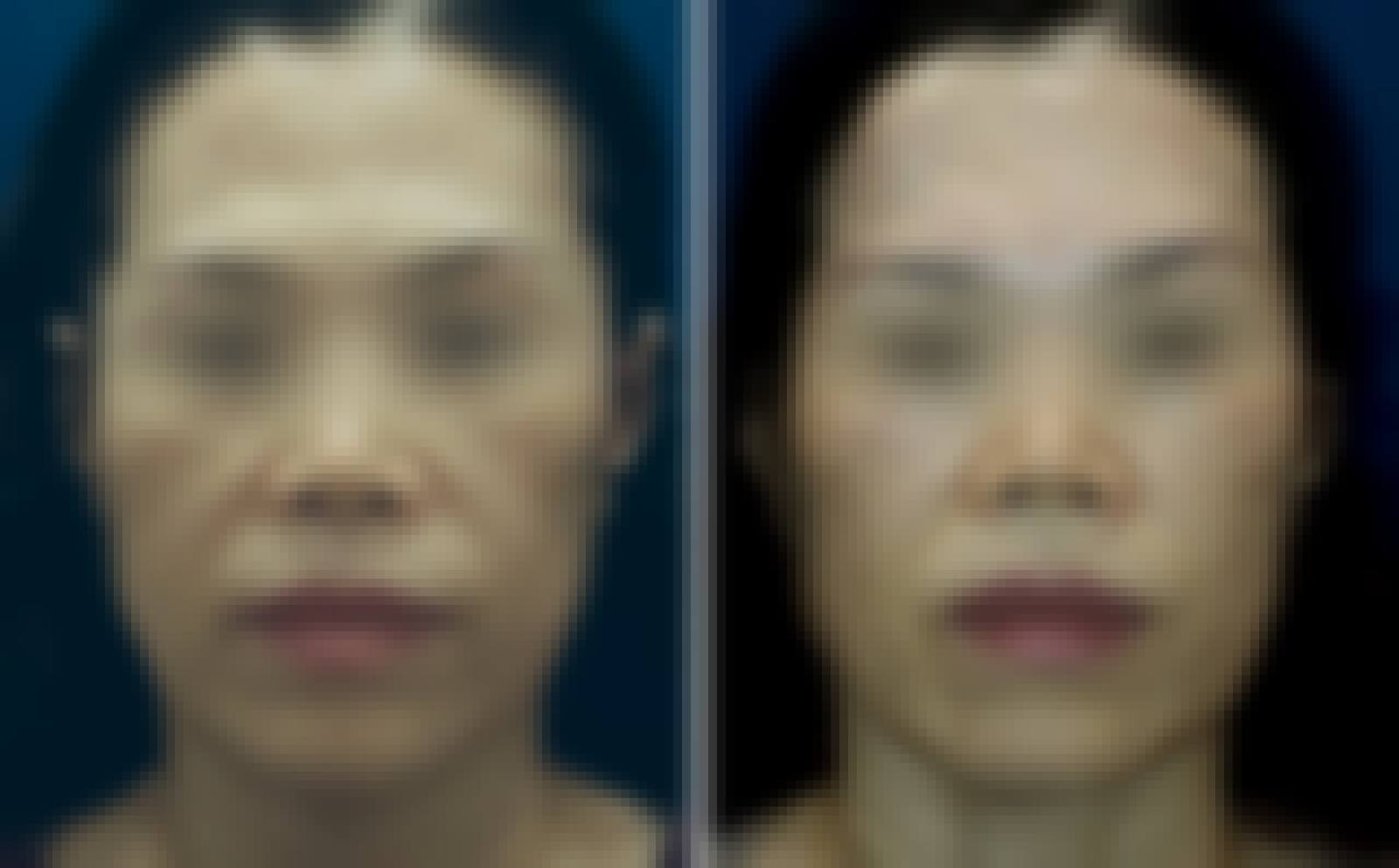
In the front-view comparison, the before image shows a forehead with an uneven surface texture — subtle hollowing or flatness that creates shadow and visual irregularity across the upper face. The after image, taken from a consistent frontal angle, shows a notably smoother surface across the full width of the forehead. The skin appears more uniformly taut, and the transition from the hairline to the brow line looks more continuous and even.
What makes this case interesting is the improvement in symmetry. In the before image, there appear to be subtle asymmetries — one side of the forehead appearing slightly flatter than the other. In the after image, the forehead reads as more balanced from left to right, which contributes to an overall impression of facial harmony rather than simply “more volume.”
The key to this result was likely precise, layered placement of filler that addressed not only the central forehead but also the subtle depressions toward the lateral aspects. Patients typically notice this kind of symmetry improvement more readily in photographs than in the mirror, because photographs freeze the comparison in a way that real-time self-assessment does not.
Lighting and angle limitations: Both images appear to use similar lighting conditions, which supports the credibility of the comparison. However, minor differences in expression or head tilt between the two images cannot be entirely excluded, and readers should interpret the photographs with that caveat in mind.
Case 2 — Side-Profile Analysis
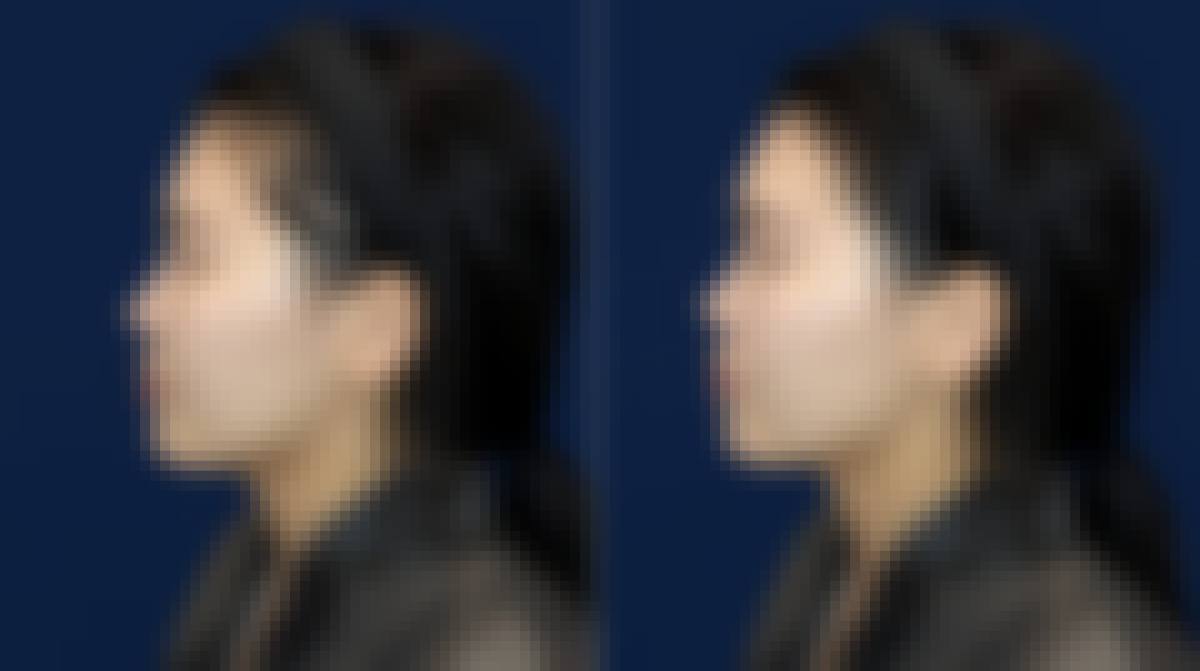
The side-profile comparison is often more revealing for forehead filler results than a frontal view, because the silhouette of the upper face is directly visible. In the before image, the profile shows a relatively flat or recessed forehead — the slope from the hairline to the brow does not have a smooth, convex arc. There is a degree of flatness or slight concavity in the mid-to-upper forehead zone that disrupts the ideal profile curve.
In the after image, the forehead profile has taken on a more rounded, convex shape. The arc from hairline to brow is smoother and projects more gently forward, which aligns with the aesthetic goal of a well-balanced profile. This kind of change is particularly meaningful for patients who feel self-conscious about their silhouette in photographs or in person.
What makes this case interesting is the naturalism of the result. The forehead does not appear overfilled or disproportionate — the projection is subtle enough to look inherent to the patient’s anatomy rather than added. This balance is one of the most technically demanding aspects of forehead filler, and it underscores why injector skill and aesthetic judgment matter as much as the product itself.
Patients typically notice side-profile improvements most clearly when looking at photographs rather than a direct mirror, because the standard mirror angle does not show the full profile easily. General guidance — not specific to this patient — suggests that HA filler results in this area may be visible for a period of several months to over a year depending on individual metabolism, lifestyle, and product characteristics. The source record for these cases does not document the specific duration.
For more before-and-after comparisons from our patients, visit our before and after gallery.
What Makes These Forehead Filler Korea Results Possible
The visible outcomes in these two cases reflect more than the properties of the filler material itself. The technique, the physician’s anatomical knowledge, and the overall treatment philosophy all shape what appears in the after photograph.
Physician-Led Injection and Anatomical Expertise
At DR.BAQUO, Dr. Park performs both the consultation and every injection personally. In a region as vascularly complex as the forehead — where branches of the supratrochlear and supraorbital arteries run close to common injection planes — physician-level anatomical knowledge is not optional. It is the foundation on which safe outcomes are built.
The forehead is not a single uniform layer. Successful results require understanding the depth at which filler should be placed in different zones of the forehead, how to distribute product evenly to avoid nodularity, and how to assess the face in three dimensions during treatment rather than only from a flat frontal perspective. Dr. Park’s assessment during consultation directly informs the treatment plan, and adjustments are made in real time during the procedure.
Product Selection at Consultation
The specific filler product and volume used are decided at consultation and are not the same for every patient. Factors that influence this decision include the degree of volume deficit, the patient’s skin thickness and elasticity, their medical history, and their aesthetic goals. The source records for the cases shown here do not specify a product brand or volume, and we do not assign a specific product to these photographs.
Generally speaking, different HA filler formulations have different rheological properties — some are softer and more spreadable, others are firmer and better suited to structural support. The choice of product matters for both the aesthetic outcome and the safety profile. This is one reason why a consultation with the treating physician — rather than an online self-assessment — is the appropriate starting point.
Combination Approaches
Some patients achieve enhanced results by combining forehead filler with other treatments, such as botulinum toxin to reduce dynamic movement in the area (which can affect filler longevity) or treatments targeting forehead skin texture. Our forehead wrinkle treatment Korea guide discusses complementary approaches in more detail. Combination planning is discussed at consultation and is individualized — we do not apply a default “package” without assessing the patient first.
For patients interested in overall facial balancing with filler, our nose filler before and after post illustrates how adjacent areas can be refined to complement forehead work.
Recovery and What to Expect After Forehead Filler Korea Treatment
General Recovery Guidance (Not Patient-Specific)
The source record for the cases shown here does not document the recovery timeline for these specific patients. The following is general guidance based on typical patterns observed with HA filler injections in the forehead area; individual experiences vary.
- Immediately after treatment: Mild swelling, redness, and tenderness at injection sites are common. Some patients experience minor bruising, particularly if small vessels are near the injection points.
- Days 1–3 (general guidance): Swelling is typically at its peak in the first 24–48 hours. Most patients can return to daily activities, though visible swelling may be noticeable to others at this stage.
- Days 4–7 (general guidance): Swelling generally subsides significantly. The forehead shape begins to approximate the final result, though the filler may still feel slightly firm or irregular during this integration phase.
- Weeks 2–4 (general guidance): The filler integrates more completely with surrounding tissue. The result feels softer and more natural. Most patients consider this the point at which they first share their result photos comfortably.
- Month 3 onward (general guidance): For most HA fillers, this is when the result has fully settled and is most representative of what the patient will maintain over the medium term.
Before and After Care Considerations
Patients are generally advised to avoid significant pressure on the treated area, intense heat exposure, and strenuous exercise immediately after treatment. Specific post-care instructions are provided at the time of treatment based on the individual case. International patients can access post-treatment follow-up via LINE (@364kbfyj), making it practical to ask questions or send photographs after returning home.
Who Is a Good Candidate for Forehead Filler Korea?
Ideal Patient Profile
Forehead filler in Korea is frequently sought by patients who:
- Have a flat or recessed forehead profile and want more rounded contour without surgery
- Have mild surface irregularities or subtle asymmetries across the forehead
- Are seeking a “smoother” forehead appearance that reads well both in person and in photographs
- Have realistic expectations about non-surgical results — understanding that filler addresses volume and contour, not deep dynamic wrinkles caused by muscle movement
- Are in good general health with no contraindications to HA filler (such as active infection in the treatment area, certain autoimmune conditions, or allergy to filler components)
Patients Who May Need Extra Caution
Forehead filler is not appropriate for all patients. Individuals with a history of complications from previous filler treatments, those on certain anticoagulant medications, pregnant or breastfeeding patients, and those with unrealistic expectations about the degree of change possible non-surgically should discuss these factors thoroughly during consultation. The forehead carries meaningful vascular risk, and this must be weighed carefully for each individual.
If significant forehead reshaping is the goal — for example, in cases of pronounced bony irregularity — surgical options may be more appropriate and should be explored with a board-certified surgeon.
International Patient Considerations
DR.BAQUO is located directly at Konkuk University Station Exit 1 (Seoul Metro Line 2), making it straightforward to reach from central Seoul or from any major hotel zone. Multilingual staff covering Chinese, Japanese, and English ensure that the consultation and treatment experience is fully communicable regardless of the patient’s language. Post-treatment follow-up is available via LINE for patients who return to their home countries after treatment, addressing the practical concern of accessing their treating physician remotely.
Patients traveling specifically for forehead filler korea treatment should plan their consultation and treatment early in their Seoul visit where possible, allowing time for initial swelling to resolve before departure. Travel-specific planning is discussed during consultation.
For a broader overview of what a filler visit to DR.BAQUO involves, see our DR.BAQUO Filler page and our Signature Program for patients considering multiple treatments in a single visit.

FAQ — Forehead Filler Before and After Questions
Q1: What does a forehead filler before and after typically look like?
A: In the cases shown here, the before images show a flatter or uneven forehead surface, and the after images show a smoother, more rounded contour — visible both from the front and in profile. Results vary significantly by individual anatomy, the volume used, and the technique applied. The photographs in this post represent real patients at DR.BAQUO but do not represent a guaranteed outcome for every person.
Q2: How much filler is typically needed for the forehead?
A: The source records for the cases shown here do not specify the volume used, and there is no universal amount — it depends on the patient’s anatomy, the degree of flatness or irregularity, and the aesthetic goal. Volume is assessed and decided at consultation. Attempting to estimate a “standard” amount without seeing the patient in person is not a clinically responsible approach.
Q3: Is forehead filler in Korea safe?
A: The forehead is a region that requires particular caution due to the proximity of significant blood vessels. The U.S. FDA has published guidance noting that certain areas of the face carry elevated vascular risk with filler injection. At DR.BAQUO, every injection is performed by Dr. Park personally — not by a technician — and all equipment is MFDS-certified. No procedure is without risk, and a thorough consultation is essential to assess individual suitability. See the FDA’s dermal filler safety page for detailed regulatory guidance.
Q4: How long do forehead filler results last?
A: The source record for the cases shown here does not document specific duration for these patients. As general guidance, HA filler results in the forehead may persist for several months to over a year depending on individual metabolism, lifestyle, and the specific product used. Longevity is discussed at consultation based on the planned treatment.
Q5: What is a “Barbie forehead” and can filler achieve it?
A: The “Barbie forehead” is an informal term for a very smooth, evenly rounded, convex forehead shape — an aesthetic that is popular in Korean beauty culture. Filler can move a patient’s forehead contour meaningfully in this direction, as visible in the before-and-after cases shown here. However, the degree of change achievable non-surgically is limited by the patient’s existing bone structure and soft tissue, and results will not be identical to a digital reference image.
Q6: What are the risks and side effects of forehead filler?
A: Common side effects include temporary swelling, redness, bruising, and tenderness. More serious risks — though less common — include vascular occlusion (blockage of a blood vessel), infection, nodule formation, and, in severe cases, vision complications if product enters a vessel connected to the eye. A systematic review of adverse events in nonsurgical facial procedures (PubMed, PMID 41047572) documents the range of complications reported in the literature. Physician-performed injections with thorough anatomical knowledge and emergency preparedness reduce but do not eliminate these risks.
Q7: How much does forehead filler cost in Korea?
A: We do not publish a price without a current verified price source, as the cost varies depending on the product selected, the volume required, and whether any combination treatments are planned. Variables that affect the quote include the degree of volume deficit, the patient’s anatomy, and the specific filler formulation chosen. We encourage patients to request a consultation — either in person at the clinic or via LINE — to receive an accurate individual quote.
Q8: Can forehead filler be combined with other treatments?
A: Yes, many patients combine forehead filler with botulinum toxin (to manage dynamic forehead movement, which can affect filler distribution and longevity), nose filler for profile balancing, or treatments targeting skin quality. Combination planning is individualized and discussed during consultation. Our forehead wrinkle treatment Korea guide provides context on complementary options for the forehead area.
Related Before & After Cases and Guides
- Lip Filler Before and After Seoul — DR.BAQUO Results
- Nasolabial Fold Filler Korea: Before and After
- Hollow Temples Treatment in Korea: Gouri & HILO WAVE Before and After
- Cheek Filler Korea: Get Natural Volume in One Day
- Nose Filler in Korea: The 15-Minute Non-Surgical Alternative
- Before & After gallery (members)
Sources and Medical References
The following verified sources support the risk, safety, and limitation statements made in this post:
- U.S. FDA — Dermal Fillers (Soft Tissue Fillers):
https://www.fda.gov/medical-devices/aesthetic-cosmetic-devices/dermal-fillers-soft-tissue-fillers
This source supports statements regarding the FDA’s position on dermal filler safety, the reversibility of HA fillers with hyaluronidase, vascular risk in certain injection areas, and the importance of injector qualifications. No specific product, brand, or injection area approval claim has been made beyond what this source supports.
- Systematic review of adverse events in nonsurgical facial procedures (PubMed, PMID 41047572):
https://pubmed.ncbi.nlm.nih.gov/41047572/
This peer-reviewed systematic review documents the range and frequency of adverse events associated with non-surgical facial procedures including dermal filler. It supports statements in this post regarding the types of complications that can occur, including vascular occlusion, nodule formation, and the importance of physician-level training for complex injection zones.
All before-and-after photographs shown in this post are real patient images from DR.BAQUO. The source records identify the treatment as forehead filler. Product brand, volume, patient age, photo interval, and session count are not recorded in the source file and have not been stated in this post.
DR.BAQUO
Hanlim Tower 2F, 229 Achasan-ro, Gwangjin-gu, Seoul
Subway: Line 2 Konkuk University Station Exit 1 (direct connection)
LINE: @364kbfyj
Website: global.drbaquo.com
—
DR.BAQUO
Hanlim Tower 2F, 229 Achasan-ro, Gwangjin-gu, Seoul
Line 2 Konkuk University Station Exit 1 (direct connection)
 WhatsApp
 LINE

 WhatsApp
 LINE
 WeChat
 Instagram
 YouTube
 TikTok
 KakaoTalk

