
If you’ve been researching facial rejuvenation and found yourself overwhelmed by the options, you’re not alone. This Korean Dermal Filler Guide exists because I see it every week in my clinic — patients who arrive in Seoul with screenshots, conflicting advice from Instagram, and real anxiety about looking “done.” Let me walk you through everything I actually tell my own patients, from how fillers work to what a one-day treatment visit in Seoul realistically looks like.
—


What Most People Get Wrong About Dermal Fillers
The “More Volume = Better Results” Misconception
The most common thing I hear when patients sit down across from me for the first time is some version of: “I just want to look less tired, but I don’t want to look fake.” And honestly? That fear is valid — because poorly planned filler treatment does look fake. The problem isn’t the filler itself. It’s the approach.
In my clinic, I see patients who’ve had filler placed elsewhere that looks overfilled, migrated, or simply wrong for their bone structure. This happens when practitioners chase volume for volume’s sake, adding product in the same areas repeatedly without assessing whether that area needs volume, structural support, or something else entirely like skin quality treatment. Filler is a tool, not a formula.
The truth is that great filler results are almost invisible. When I treat a patient’s nasolabial folds, cheeks, or temples well, their friends should notice they look “refreshed” or “well-rested” — not that they’ve had something done. That’s the standard I hold myself to, and it’s the standard this guide is built around.
Why Choosing the Right Filler Type Matters More Than You Think
Not all hyaluronic acid fillers are the same, and this is something even experienced filler patients are often surprised to learn. The difference between a soft, low-G-prime HA filler used for lip hydration and a firm, high-G-prime filler designed for jawline definition is enormous. Using the wrong product in the wrong tissue plane leads to either no effect or an unnatural result.
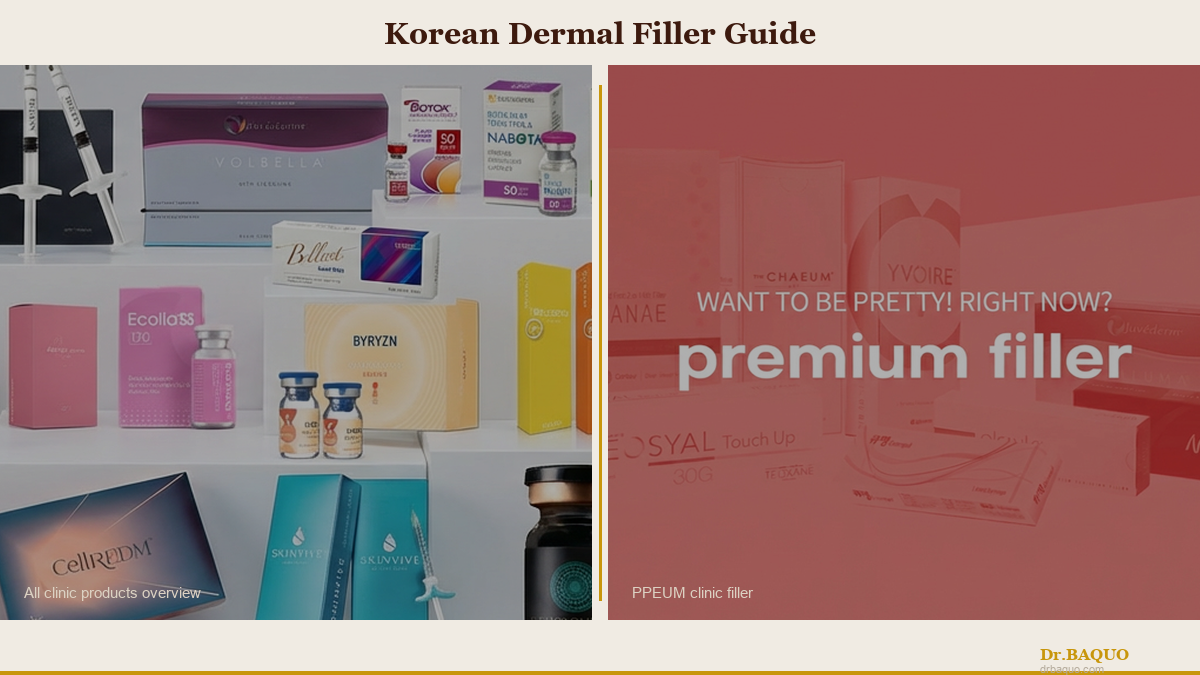
In Korea, we have access to a wide range of internationally validated filler brands — Juvederm, Restylane, Belotero, Ellanse, and more — each with specific viscosities designed for specific anatomical layers. When I do a face-mapping assessment before every treatment, I’m deciding not just where to inject, but which product at which depth with what technique. That layered decision-making is what separates a natural result from one that looks off.
—
Understanding How Korean Dermal Fillers Work
The Science of Hyaluronic Acid in Skin
A dermal filler is a gel-like substance injected beneath the skin surface to restore lost volume, smooth folds, define contours, or improve overall facial proportions. The most widely used type — and the one I use most frequently at my clinic — is hyaluronic acid (HA) filler. HA is a naturally occurring sugar molecule found in your skin, joints, and connective tissue. It attracts and binds water, which is precisely why it’s so effective at creating soft, natural-looking volume when injected.
What most patients don’t realize is that as we age, we lose HA, collagen, and bone density simultaneously. This isn’t just “sagging skin” — it’s a structural change in the face. Volume loss in the cheeks causes the midface to flatten, which in turn pulls down the nasolabial folds and creates jowling at the jawline. A comprehensive Korean dermal filler guide has to address this full picture, not just individual wrinkles in isolation.
HA fillers injected by a skilled practitioner integrate with surrounding tissue and stimulate some degree of collagen production, though the primary mechanism is volume replacement. Most HA fillers last between 9 and 18 months depending on the product, the area treated, and the individual’s metabolism. Lip fillers typically dissolve faster than cheek or jawline fillers due to the higher movement in that area.
Biostimulators vs. HA Fillers: When Each Is Appropriate
Beyond traditional HA fillers, there are biostimulating injectables that I frequently combine with filler treatments — particularly for patients over 40. Products like Sculptra (poly-L-lactic acid) and Ellanse (polycaprolactone) don’t add immediate volume the way HA fillers do. Instead, they stimulate your own collagen production over weeks to months, gradually improving skin thickness and structural support.
I often describe it to my patients this way: HA filler is like renovating a room — it gives you a beautiful result immediately. Sculptra is like reinforcing the building’s foundation — the results are slower but they build something more durable underneath. For many of my patients in their 40s and 50s, I design protocols that combine both approaches, addressing immediate volume needs with HA while rebuilding collagen infrastructure with biostimulators. If you’re curious about how Sculptra works specifically, I’ve written a detailed guide on Sculptra Korea that walks through the full process.
 WhatsApp
 LINE
LINE WeChat
 KakaoTalk
—
How Dr. Baquo Approaches Filler Treatment
Face Mapping Before Every Session
Dr. Baquo is a board-certified aesthetic medicine specialist in Gangnam, Seoul, and the principle I’ve built my practice around is this: every face is different, and every treatment plan should be too. Before I inject anything, I spend time analyzing my patient’s facial anatomy — bone structure, soft tissue distribution, skin quality, asymmetries, and the relationship between different facial thirds.
I use what I call a face-mapping assessment, where I photograph and analyze the face under clinical lighting and ask the patient to show me their concerns in the mirror. This conversation matters enormously. Sometimes a patient comes in asking for cheek filler, but when I look at their face, I can see their real issue is temple hollowing — which is pulling everything down. Treating the wrong area won’t solve the problem; it might make it worse.
I also assess whether filler is actually the right tool, or whether a lifting treatment like Ultherapy or Thermage FLX would better serve the patient’s goals. About 70% of my international patients end up with multi-treatment plans — for example, combining cheek filler with a skin booster for hydration, or pairing jaw filler with Botox for a more complete V-line effect. For patients interested in jaw shaping specifically, my post on Jawline Botox in Korea explains how I approach that combination.
Injection Technique and Safety Standards
The technique used during filler injection matters as much as the product choice. I personally perform every injection at my clinic — I don’t delegate energy treatments or injectable procedures to nurses or trainees. This is a non-negotiable standard for me, and it’s one I wish more clinics made explicit.
For deeper structural areas like the cheek and temple, I typically use a cannula rather than a sharp needle. Cannulas are blunt-tipped instruments that navigate through tissue more safely, dramatically reducing the risk of vascular injury. For more precise surface work like fine lip lines or tear troughs, I may use a needle, but always with careful attention to depth and pressure.
In terms of safety, I maintain a full emergency protocol at the clinic, including hyaluronidase — the enzyme that dissolves HA filler — available at all times. Every international patient also receives follow-up communication after returning home, so I can monitor healing and answer questions remotely.
—
Real Patient Scenarios: Korean Dermal Filler in Practice
The Mid-30s Patient: Prevention and Subtle Enhancement
I recently treated a patient in her mid-30s who flew in from Singapore specifically because she wanted “maintenance” filler — not dramatic change, just preservation of what she felt was starting to fade. She pointed to mild flattening in her midface and the early appearance of nasolabial shadow.
For her, I used a small amount of a medium-viscosity HA filler in the deep cheek fat compartments — not on the surface, but anchored to the periosteum (the bone layer) for structural lift rather than surface puffiness. The result was a natural midface lift that subtly repositioned her soft tissue without adding visible volume. She flew home the same evening and told me via LINE that her colleagues thought she “looked well-rested.” That’s exactly the goal.
This kind of early intervention also has a preventive benefit. Maintaining facial volume and structural support in the 30s often means you need less aggressive treatment in the 40s and 50s. I pair this approach with skin quality treatments like Profhilo Korea or skin boosters to address hydration alongside volume — because great skin texture and great structure together produce results that look genuinely healthy rather than just filled.
The 50s Patient: Structural Restoration With Multiple Tools
My patients in their 50s typically present with a combination of volume loss, skin laxity, and changing facial proportions. For this group, a single filler session is rarely the most effective approach — and I always tell them that upfront.
For one patient from Tokyo who visited last year, we created a staged treatment plan: on her first visit, we placed biostimulating filler (Ellanse) in the midface and temples to begin collagen rebuilding, combined with HA filler at the jawline for immediate definition. On a follow-up visit six weeks later, we added targeted treatment for her lower face. Between sessions, she used the Gouri PCL protocol for overall skin liftiness. Her results at the three-month mark were significantly better than anything a single large-volume session would have achieved — because we worked with her anatomy rather than trying to fill everything at once.

—
Frequently Asked Questions About Korean Dermal Filler Guide
How long do dermal fillers last in Korea?
Most hyaluronic acid fillers used in Korea last between 9 and 18 months, depending on the product type, the area treated, and individual metabolism. Lip fillers typically dissolve faster — around 6 to 9 months — because of frequent muscle movement. Deeper structural fillers in the cheeks or jawline often last closer to 12 to 18 months. Biostimulating fillers like Sculptra or Ellanse can produce results that last 2 years or more, since they work by stimulating your own collagen rather than simply adding gel volume.
Is dermal filler in Korea safer than in my home country?
Safety in aesthetic medicine depends on the practitioner’s skill, the product’s authenticity, and the clinic’s emergency protocols — not the country. That said, Korea’s MFDS (Ministry of Food and Drug Safety) certification standards are rigorous, and Korean aesthetic medicine has a globally recognized reputation for technical precision. At my clinic, I only use MFDS-certified, traceable products, I personally perform every injection, and I keep hyaluronidase on hand at all times for emergency reversal if ever needed.
What areas can be treated with fillers in one visit?
In a single session, I can treat multiple areas — including cheeks, temples, nasolabial folds, jawline, chin, and lips. For international patients planning a one-day visit, I typically recommend focusing on 2 to 3 areas for the most comfortable experience with predictable healing. Treating too many areas at once increases swelling and makes it harder to evaluate results clearly. During your photo pre-consultation, we’ll agree on a realistic priority list for your visit.
How much does Korean dermal filler cost compared to other countries?
Korean dermal filler pricing is generally more competitive than equivalent treatment in the US, UK, Australia, or Japan — often 30 to 50% lower for the same premium products. The cost per syringe at reputable Seoul clinics typically ranges from approximately 200,000 to 600,000 KRW depending on the product and area. However, I always caution patients against choosing a clinic based on the lowest price — the injector’s skill and product authenticity matter far more than small price differences.
Can I combine filler with other treatments on the same day?
Yes, in many cases — and this is actually one of the advantages of visiting a dedicated aesthetic clinic like mine. I regularly design same-day combination protocols for international visitors. Common pairings include cheek filler with skin booster injections, jawline filler with Botox for jaw slimming, or lip filler combined with a laser toning session. I decide what can be safely combined based on the specific treatments involved and the patient’s skin condition. Not everything can be done simultaneously, so pre-consultation is essential for planning.
Will people be able to tell I’ve had filler done?
With skilled injection technique, most people will not be able to identify that you’ve had filler — they’ll simply notice that you look refreshed, well-rested, or more defined. The key is conservative, anatomy-specific treatment. I always say that the best filler result is one your friends can’t explain. Immediately after treatment, mild swelling may be visible for 24 to 72 hours, but this resolves naturally and is easily managed with simple aftercare.
What’s the difference between Korean filler brands and Western brands?
Many of the same internationally recognized brands — including Juvederm (Allergan), Restylane (Galderma), and Belotero (Merz) — are used in Korea alongside Korean-developed products. Korean aesthetic medicine is known for its injection artistry and customization rather than relying on any single proprietary product. What tends to differ is the approach: Korean practitioners typically use lower volumes with higher precision, prioritizing natural-looking outcomes over dramatic volume changes. The skill of the injector and the mapping of the face are what make results look Korean in the best sense.
—
Ready for your 1-day transformation in Seoul?
Contact Dr. Baquo via WhatsApp/LINE: drbaquo
Website: drbaquo.com
—
TREATMENT PRICING
| Imported Elf Ear Filler 1cc | ₩450,000 | |
| Chin Filler 1cc 1 sessions Special Price | ₩77,000 | ₩39,000 |
| ChinFiller 1cc 1 sessions Special Price | ₩89,000 | ₩45,000 |
| Domestic Shoulder Filler 10cc | ₩750,000 | ₩390,000 |
* Prices reflect current promotional rates and may change. Final pricing is confirmed during consultation.
 WhatsApp
 LINE
LINE
 WhatsApp
 LINE
LINE WeChat
 Instagram
 YouTube
 TikTok
 KakaoTalk
