
Nasolabial fold filler before and after results are among the most searched aesthetic outcomes for patients considering treatment in Korea. The deep lines that run from the base of the nose to the corners of the mouth — commonly called smile lines or laugh lines — can make the face appear tired or older than it feels. At DR.BAQUO, we approach nasolabial fold filler with a focus on natural volume restoration, using Juvederm hyaluronic acid filler to soften these creases without creating an overdone or puffy appearance. For patients comparing the exact search phrase “nasolabial fold filler Korea,” this guide uses verified clinic cases rather than generic stock examples. In this post, we share real before and after photographs from our clinic, walk through what the images actually show, and explain the honest clinical thinking behind each result.
Quick Answer: The before and after photographs shown in this post document visible softening of the nasolabial fold area following Juvederm hyaluronic acid filler treatment at DR.BAQUO in Seoul. In both cases, the depth and shadow of the fold appear reduced in the after images when compared to the before images under similar lighting conditions. Outcomes vary meaningfully between individuals depending on skin laxity, fold depth, anatomy, and treatment plan — these photographs represent one possible outcome, not a guaranteed result.
What Is Nasolabial Fold Filler? — How It Works
Nasolabial fold filler is a minimally invasive injectable treatment that places hyaluronic acid (HA) gel beneath the skin to restore lost volume and physically lift the crease from within. Hyaluronic acid is a naturally occurring substance in the body that attracts and binds water molecules, which is why HA-based fillers are able to add soft, hydrated volume to targeted areas. Juvederm, the product used in the cases shown in this post, is a cross-linked hyaluronic acid filler produced by Allergan Aesthetics.
How Hyaluronic Acid Filler Creates a Visible Before and After Difference
The nasolabial fold forms primarily because of two processes that happen gradually with age: volume loss in the mid-face (particularly in the malar fat pads and deep fat compartments of the cheek) and skin laxity that allows tissue to fold downward. Juvederm filler addresses the volume component directly. When injected along or above the fold, the gel physically fills the space beneath the crease, reducing the shadow and depth that make the line appear prominent in photographs and in daylight.
Unlike energy-based devices that work over weeks by stimulating collagen, HA filler produces a structural change that is visible almost immediately after injection, though swelling in the first several days means the true settled result takes time to assess. Because hyaluronic acid is gradually broken down by the body’s own enzymes, the result is not permanent — this is both a safety advantage and a planning consideration for patients.
Safety Profile and Regulatory Status
According to the U.S. Food and Drug Administration’s dermal filler patient safety information, hyaluronic acid fillers are among the most studied injectable aesthetic products, and hyaluronidase — an enzyme that dissolves HA — is available as a reversal agent in the event of an adverse outcome. The FDA notes that all dermal fillers carry risks including bruising, swelling, infection, and, in rare cases, vascular occlusion. At DR.BAQUO, all equipment and products used in treatment are MFDS-certified, and certification displays are visible within the clinic. We recommend that prospective patients read the FDA’s patient safety page (linked in our sources section below) before booking any injectable treatment, whether in Korea or elsewhere.
 WhatsApp
 LINE
LINE
 KakaoTalk
Nasolabial Fold Filler Before and After — Case Analysis
The two before and after cases shown in this post were treated at DR.BAQUO in Seoul. The source records identify each case by treatment type only; they do not specify the patient’s age, injected volume, photo interval, or a guaranteed duration of result. We present what the photographs show and note where the lighting or angle creates limitations in interpretation.
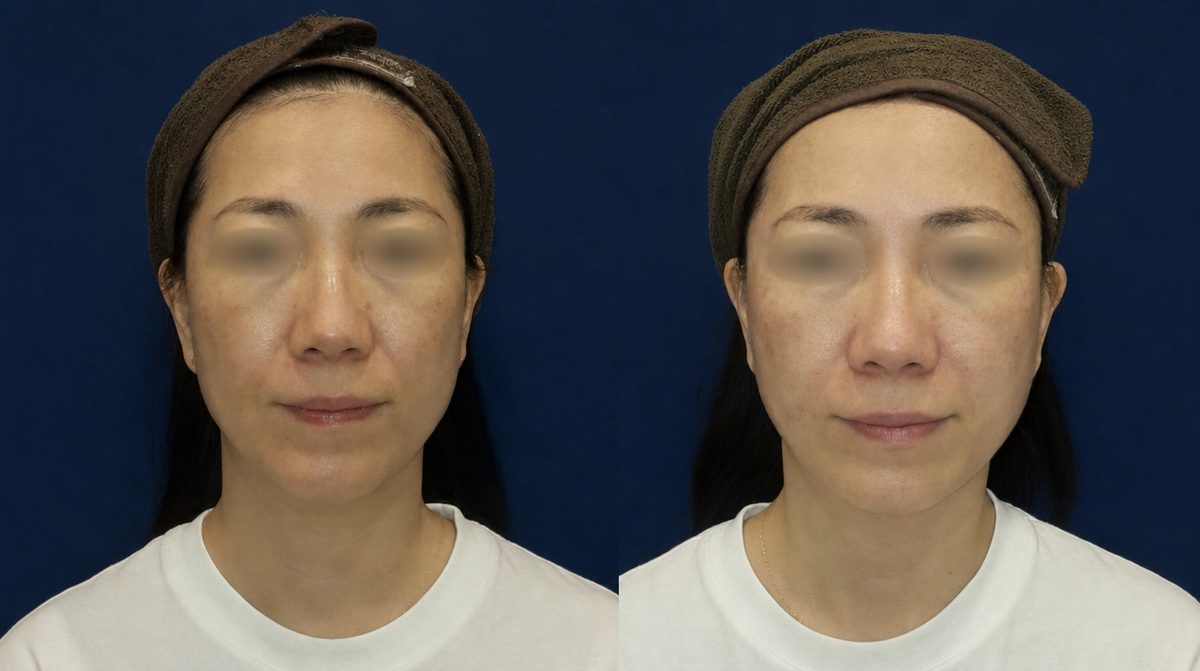
Case 1 — Nasolabial Fold Filler Combined with Thread Lifting
The first before and after image shows a patient treated with a combination approach: Juvederm hyaluronic acid filler for the nasolabial fold area alongside thread lifting. What makes this case particularly interesting is the dual mechanism at work — filler addresses the volume deficit beneath the fold while threads provide upward mechanical support to the soft tissue that has descended over the fold.
In the before image, a pronounced bilateral fold is visible, casting a clear shadow from the alar base downward toward the corner of the mouth on both sides. The surrounding mid-cheek area shows signs of volume loss, which is a common contributing factor to fold depth. In the after image, taken under lighting conditions that appear consistent with the before photograph based on background and skin tone rendering, the fold shadow is visibly reduced on both sides. The transition from the cheek to the nasal base appears smoother, and the skin surface around the fold looks less creased.
The key to this result was the combination strategy. Filler alone can soften the fold from below, but when mid-face laxity is a contributing factor, adding structural thread support can improve the overall contour of the lower-to-mid face in ways that single-modality treatment may not fully achieve. Patients considering this type of combined approach can explore our Signature Program for more information about how DR.BAQUO structures multi-treatment plans.
Photograph limitations: Both images in Case 1 appear to be taken from a similar distance and angle (slight anterior three-quarter view). Minor differences in head tilt between the two frames mean that fold depth on one side may appear slightly different from the other independent of treatment effect. We describe only what is observable in the supplied images.
Case 2 — Nasolabial Fold Filler (Juvederm Only)
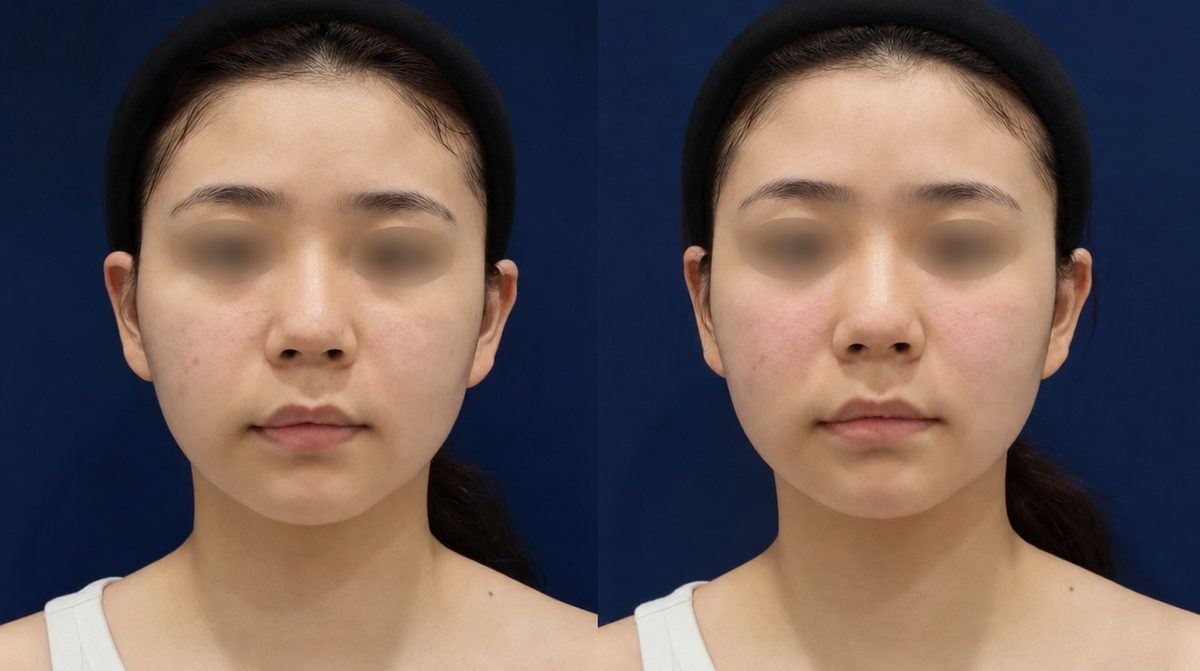
The second before and after image documents a case where Juvederm hyaluronic acid filler was used for the nasolabial fold without the addition of threads. This case is informative as a more direct illustration of what filler alone can achieve in a suitable candidate.
In the before image, the nasolabial fold is present bilaterally, with the crease appearing as a defined line running from the lateral nostril to the corner of the mouth. The skin surface along the fold shows minor surface irregularity consistent with a fold that has been present for some time. In the after image, the fold depth appears meaningfully reduced. The shadow along the fold line is lighter, and the transition from the cheek body to the upper lip area looks softer. The overall facial expression in the after image appears more rested without appearing overfilled or unnatural.
Patients typically notice the most dramatic change in photographs taken in overhead or angled lighting, where fold shadows are exaggerated — this is also where before and after comparisons are most visually striking. The settled appearance in this after image suggests swelling from the injection has resolved, though the source record does not specify the photo interval so we cannot confirm the exact timing.
For patients interested in exploring a broader range of before and after cases, our Before and After Gallery includes additional documented results across treatment types.
What Makes These Results Possible
Achieving a natural-looking nasolabial fold filler before and after result — rather than a puffy or distorted one — depends on technique, product selection, and a clear understanding of the patient’s underlying anatomy. At DR.BAQUO, Dr. Park performs both consultation and treatment personally. Every injection is the doctor’s own hand: there is no delegation of the injection step to a nurse or technician. This matters particularly for a treatment like nasolabial fold filler, where the placement depth, injection point, and volume distribution in each pass determine the balance between adequate correction and overfill.
The Role of Juvederm in This Treatment Area
Juvederm is a range of cross-linked hyaluronic acid fillers with different rheological properties — meaning different levels of stiffness, elasticity, and flow — suited to different tissue depths and anatomical locations. The nasolabial fold area typically requires a product that integrates well with the tissue at the dermal or subdermal level without migrating and that provides sufficient lift without creating a visible ridge. The specific Juvederm product selected for each patient depends on fold depth, skin thickness, and the degree of volume correction needed. The source records for the cases shown in this post identify Juvederm as the product used; they do not specify which product variant from the Juvederm range was selected.
Why Results Vary Between Patients
The nasolabial fold is not a single structure — it is the visible result of the interaction between the malar fat pad, the superficial musculoaponeurotic system (SMAS), the overlying dermis, and the nasolabial fold muscle itself. Two patients with folds that look similar in a mirror may have very different underlying contributors: one may benefit most from cheek filler to restore mid-face volume (which indirectly lifts the fold), while another may need direct fold filler, and a third may need both filler and thread support as shown in Case 1. This anatomical reality is why a consultation — rather than a fixed package — is the starting point at our clinic.
Our Dermal Filler Korea Complete Guide explains the range of HA filler options and the planning process in more detail, and our Smile Lines guide covers the anatomy of nasolabial folds in accessible language for patients researching before their appointment.
What This Clinic Does Differently
DR.BAQUO is located directly at Konkuk Station Exit 1, making it straightforward to access for international patients arriving from central Seoul or Incheon Airport. Multilingual staff covering Chinese, Japanese, and English support communication throughout consultation, treatment, and aftercare. For patients returning home after treatment, post-treatment follow-up is available via LINE (@364kbfyj), which allows patients to send photographs and receive clinical guidance without requiring an in-person visit.
Recovery and What to Expect After Nasolabial Fold Filler Korea Treatment
The source records for the cases in this post do not specify recovery timelines for these individual patients. The following is general guidance for HA filler in the mid-face area, which should be confirmed with your treating physician as individual responses vary.
General Recovery Progression (Labeled as General Guidance)
- Day 1: Injection site swelling, possible pinpoint bruising at entry points. The treated area may feel slightly firm to the touch as the filler settles into the tissue. Most patients are comfortable returning to non-strenuous activities the same day.
- Days 2–4: Swelling typically peaks within the first 48 hours then gradually resolves. Bruising, if present, generally follows the same timeline as bruising from other minor skin procedures. Cold compresses can help during this window.
- Days 5–10: The majority of post-treatment swelling has resolved for most patients in this general timeframe. The filler begins to integrate with the surrounding tissue and feels more natural to the touch.
- Week 2–4: The result continues to soften and settle. Many patients find that photographs taken at this stage more closely resemble the settled, long-term outcome they will maintain.
- Month 1–3: For most patients, this is when the result has fully stabilized. This is also the appropriate window for a follow-up assessment if any additional refinement is desired.
Before and After Care Instructions (General Guidance)
Before treatment, patients are generally advised to avoid blood-thinning medications and supplements (such as aspirin, fish oil, and vitamin E) for approximately one to two weeks prior to injection — this is a general guideline that should be confirmed with your treating physician. Alcohol is typically avoided in the 24 hours before and after treatment.
After treatment, patients are generally advised to avoid strenuous exercise, heat exposure (saunas, steam rooms), and facial massage of the treated area for a short period following injection. Sun protection of the treated area is advisable.
Who Is a Good Candidate for Nasolabial Fold Filler Korea?
Concerns This Treatment Addresses Best
Nasolabial fold filler is typically most suited to patients whose primary concern is the depth of the nasolabial fold itself, particularly where volume loss is a contributing factor. Candidates who tend to respond well in clinical experience include:
- Patients with moderate fold depth where the crease is consistently visible at rest, not only when smiling
- Patients who have experienced gradual facial volume loss with aging, making the fold appear more prominent
- Patients with skin that retains reasonable elasticity, so that restored volume can be supported by the surrounding tissue
- Patients seeking a non-surgical, reversible option with no significant downtime commitment
When to Consider Alternatives or Additions
Patients with significant skin laxity or very deep folds may benefit from a combination approach, as shown in Case 1 of this post, where thread lifting is added to mechanical support from the filler volume. Patients whose nasolabial fold is primarily driven by descending mid-face tissue may achieve a better result with cheek or mid-face filler rather than — or in addition to — direct fold filler. Our Under-Eye Filler Guide may also be relevant for patients concerned about the overall appearance of mid-face aging, as tear trough hollowing and nasolabial fold depth are often addressed together.
We do not present a clinic price in this post because the total cost of treatment depends on variables including the specific Juvederm product variant selected, the volume required for meaningful correction, and whether a combination approach is indicated. We direct prospective patients to consultation for an accurate and personalized quote.
International Patient Planning in Seoul
DR.BAQUO’s position at Konkuk Station Exit 1 means patients arriving by subway from Gimpo or Incheon Airport can reach the clinic on a single line transfer. Consultations with Dr. Park are available in English, Chinese, and Japanese through multilingual staff, and the clinic’s LINE account supports pre-visit questions and post-visit follow-up, which is particularly practical for patients who will be traveling home within days of treatment.

FAQ — Nasolabial Fold Filler Korea Before and After Questions
Q: Is nasolabial fold filler safe?
A: Hyaluronic acid fillers, including Juvederm, are among the most studied injectable aesthetic treatments. According to the U.S. FDA’s dermal filler patient safety information, risks include bruising, swelling, infection, and — in rare cases — vascular complications. A published systematic review of adverse events in nonsurgical facial procedures (indexed on PubMed) identifies vascular occlusion as the most serious risk category for injectable treatments in the mid-face. At DR.BAQUO, all treatment is performed personally by Dr. Park and uses MFDS-certified products. Patients should discuss their full medical history and medication list during consultation. The availability of hyaluronidase as a reversal agent is an important safety feature specific to HA fillers.
Q: What do nasolabial fold filler before and after photos actually show?
A: In the cases documented in this post, the before and after photographs show a visible reduction in the depth and shadow of the nasolabial fold area following treatment. The after images appear to show a smoother transition from the cheek to the upper lip area. Photographs have inherent limitations — lighting differences, expression variation, angle, and timing relative to swelling resolution all affect how a result appears in an image. We describe only observable changes and note any limitations in each case analysis.
Q: How long do nasolabial fold filler results last?
A: The source records for the cases shown in this post do not specify a duration for these individual patients. As general guidance, HA fillers in the mid-face area are metabolized over time by the body. Duration is influenced by the specific product used, the patient’s metabolism, the volume injected, and the degree of facial movement in the area. We do not state a specific durability figure for these cases and recommend discussing realistic expectations during consultation.
Q: How many sessions of nasolabial fold filler are needed?
A: The source records do not specify the number of sessions for the cases shown. Some patients achieve their desired correction in a single appointment; others prefer a gradual approach across more than one session. The appropriate plan depends on fold depth, anatomy, and the patient’s preference regarding the pace of change.
Q: How much does nasolabial fold filler cost in Korea?
A: We do not present a clinic price in this post because the cost varies depending on which Juvederm product variant is selected, the volume required, and whether a combination approach is indicated. Korea is frequently sought as a destination for aesthetic treatment because of its combination of clinical expertise and competitive pricing relative to Western markets, but pricing varies significantly between clinics. We direct prospective patients to consultation for an accurate quote specific to their anatomy and goals.
Q: What is the difference between nasolabial fold filler alone and the filler-plus-thread combination shown in Case 1?
A: Filler addresses volume loss beneath the fold by physically filling the space under the crease. Thread lifting adds mechanical upward support to soft tissue that has descended with age, pulling tissue in the direction that reduces fold prominence. In patients where both volume loss and tissue descent contribute to the fold’s appearance, combining both approaches can produce a more complete result than either treatment alone. A consultation is needed to determine which approach is appropriate.
Q: Can nasolabial fold filler results look unnatural?
A: Overfilling the nasolabial fold area is a recognized risk that can produce a puffy or pillow-like appearance that looks unnatural, sometimes referred to informally as “filler face.” At DR.BAQUO, the goal is a natural-looking result — visible improvement without distortion of the face’s natural proportions. This requires careful volume calibration and a thorough understanding of individual facial anatomy. The before and after photographs shown in this post illustrate outcomes where the face retains its natural structure while the fold appears softer.
Q: Is it safe to get nasolabial fold filler in Seoul as an international patient?
A: Medical tourism for aesthetic treatment in Seoul is common, and Korea has a well-developed aesthetic medicine infrastructure. Practical considerations for international patients include planning for the first week of recovery (when swelling and bruising may be most visible) to coincide with time in Seoul, and arranging post-treatment follow-up if concerns arise after returning home. DR.BAQUO offers LINE-based follow-up for international patients and has multilingual staff to support communication before, during, and after treatment. As with any medical procedure abroad, patients should research their treating physician’s credentials and ensure the clinic uses certified products and equipment.
Sources and Medical References
The following verified sources were used to support the risk, safety, and regulatory statements in this post. They are not cited in support of any specific clinical claims about individual patient outcomes.
U.S. FDA — Dermal Fillers (Soft Tissue Fillers) Patient Safety Information
FDA Dermal Filler Patient Safety Information
This source supports statements about the availability of hyaluronidase as a reversal agent for HA fillers, the general risk categories associated with dermal fillers (bruising, swelling, infection, vascular complications), and the FDA’s characterization of HA fillers as among the most studied injectable aesthetic products.
PubMed — Systematic Review of Adverse Events in Nonsurgical Facial Procedures (2024)
Systematic review: adverse events in nonsurgical facial procedures — PubMed
This peer-reviewed systematic review supports statements about vascular occlusion as the most serious risk category for injectable treatments in the mid-face area, and underpins our recommendation that patients discuss their anatomy and medical history thoroughly during consultation before proceeding with any injectable treatment.
Specific claims about the Juvederm product range, product properties, and treatment approach reflect general clinical knowledge of the product category. Individual treatment decisions at DR.BAQUO are made by Dr. Park at consultation based on each patient’s specific anatomy, and are not presented as representative of a universal protocol.
DR.BAQUO | Hanlim Tower 2F, 229 Achasan-ro, Gwangjin-gu, Seoul
Subway: Line 2 Konkuk University Station Exit 1 (direct connection)
Google Maps | LINE: @364kbfyj | global.drbaquo.com
—
DR.BAQUO
Hanlim Tower 2F, 229 Achasan-ro, Gwangjin-gu, Seoul
Line 2 Konkuk University Station Exit 1 (direct connection)
 WhatsApp
 LINE
LINE

 WhatsApp
 LINE
LINE WeChat
 Instagram
 YouTube
 TikTok
 KakaoTalk
