
Laser toning in Korea has earned a strong reputation among patients seeking clearer, more even-toned skin — and the before and after results at DR.BAQUO show exactly why. For patients comparing the exact search phrase “laser toning Korea,” this guide stays tied to a verified clinic case. In this post, we walk through a real dual laser toning plus pigment spot laser case treated at our clinic in Seoul, breaking down what changed, what the photographs actually show, and what any prospective patient should realistically expect.
Quick Answer: The before and after photographs in this post show a visible reduction in surface pigmentation across the treated area, along with an improvement in overall skin tone evenness. The after image reflects the state of the skin at the time the photo was taken — outcomes vary between individuals based on skin type, pigmentation depth, and other factors that cannot be determined from photographs alone.
What Is Dual Laser Toning? — How the Treatment Works
Dual laser toning is a two-stage laser approach designed to address uneven skin tone, diffuse pigmentation, and surface irregularities that affect the overall clarity and luminosity of the skin. At DR.BAQUO, we approach laser toning with a focus on layering complementary laser energies to achieve results that a single-modality treatment may not produce on its own.
The Core Principle
The “dual” in dual toning refers to the use of two distinct laser passes — typically targeting different layers or pigment characteristics of the skin — delivered in a single session or as a coordinated protocol. The first pass works broadly across the treatment zone to suppress melanin activity and encourage a more uniform baseline tone. The second pass, often delivered at different parameters, refines and reinforces the first.
In this documented case, a pigment spot laser was added as a third targeting step, directing focused energy specifically at discrete areas of concentrated pigmentation — the kind of visible brown or grey spots that sit distinctly against the surrounding skin. This is a meaningful clinical distinction: broad toning addresses diffuse, scattered pigment; spot laser addresses focal lesions with precision.
Why Laser Toning Produces Visible Before and After Differences
Melanin — the pigment responsible for spots and uneven tone — absorbs laser energy selectively. When the laser pulse reaches pigmented cells, it disrupts the melanin clusters, allowing the body’s natural clearance processes to reduce their surface appearance over time. The American Academy of Dermatology notes that laser treatments can address a range of skin conditions including pigmentation, and that results depend on the type and depth of the concern being treated. You can read more about conditions lasers can treat at the AAD’s resource page.
Safety Profile and Regulatory Context
The U.S. FDA provides an overview of aesthetic laser devices and the regulatory framework under which they operate — a useful reference for patients researching treatment safety internationally. The FDA’s aesthetic device overview outlines the general categories of devices used in cosmetic procedures. At DR.BAQUO, all equipment is MFDS-certified, with visible certification displays in the clinic — patients are welcome to review these during their consultation.
The source record for the case shown in this post confirms that dual toning and a pigment spot laser were performed. It does not specify the device model, wavelength settings, number of sessions, or the interval between the before and after photographs. We have not inferred these details, as doing so would misrepresent what is actually documented.
To learn more about how laser toning works as a foundational treatment, our DR.BAQUO Laser Toning guide provides a detailed overview of the protocol and what patients can expect at our clinic.
 WhatsApp
 LINE
LINE
 KakaoTalk
Laser Toning Before and After — Case Analysis
This section analyzes the single before and after case documented in this post. We describe only what is visible in the supplied photograph. We do not infer the patient’s age, sex, diagnosis, or the interval between images, as the source record does not specify these details.
What the Photographs Show
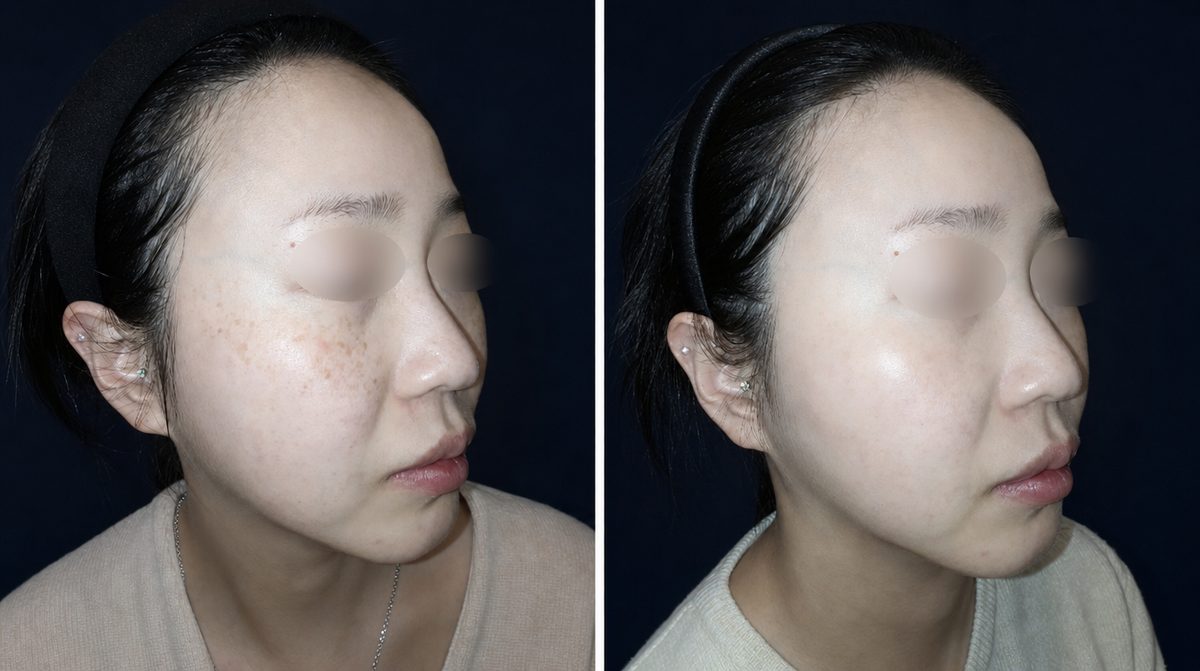
The before image shows skin with visible pigmented areas distributed across the treatment zone. Several discrete spots are apparent — appearing darker than the surrounding skin — alongside a general unevenness in base tone that gives the complexion a mottled or inconsistent appearance.
The after image, taken from a comparable angle and under similar lighting conditions, shows a meaningful reduction in the intensity and prominence of the discrete pigmented spots. The focal lesions that were most visible in the before image appear lighter and less defined in the after image. The overall base tone of the skin also appears more consistent, with less of the mottled unevenness visible in the before photograph.
It is worth noting that lighting, camera distance, and skin preparation can all influence how pigmentation appears in photographs. While the comparison appears to reflect genuine improvement, photographs alone cannot confirm the mechanism, depth of effect, or durability of the outcome. What the photographs show is the condition of the skin at two different points in time — they do not prove that results are permanent or that the same outcome would be replicated in another patient.
The Role of the Spot Laser Addition
What makes this case clinically interesting is the combination approach. Dual toning alone addresses the broader tonal landscape of the skin; the addition of a targeted pigment spot laser allows the treating physician to address individual focal lesions with greater precision. In the before image, several discrete spots are visible that would likely benefit more from focal targeting than from broad toning alone. The after image appears to reflect the impact of this combined approach — both the diffuse unevenness and the specific focal spots have changed in a way consistent with both modalities working in coordination.
Candidate Profile Reflected in This Case
The case reflects a patient presenting with both diffuse pigmentation concerns and discrete surface spots — a profile that is common among patients seeking laser toning in Korea. The source record does not identify the patient’s age, skin type classification, or prior treatment history, so we cannot generalize beyond what the photographs show.
For patients curious about how this type of result compares across different cases, our before and after gallery includes additional documented outcomes across a range of concerns and treatments.
What Makes These Results Possible
The outcome shown in this case does not happen by default — it reflects a deliberate clinical decision to layer two complementary laser approaches rather than relying on a single modality. At DR.BAQUO, the treatment protocol for pigmentation concerns is always determined through direct physician assessment, not templated packages.
Dr. Park’s Hands-On Approach
Dr. Park performs both the consultation and the treatment personally. Every laser pulse is delivered by the doctor’s own hand — not delegated to a technician or assistant. This matters in pigmentation cases because the judgment calls made during treatment — how to feather energy at the border of a spot, when to adjust parameters mid-session, which areas require additional attention — require clinical experience that cannot be replicated by protocol alone.
This is particularly relevant when treating a combination of diffuse toning needs and focal spot concerns in the same session, as shown in this case. The transition between the broad toning pass and the precision spot laser work requires a treating physician who is making real-time assessments, not following a fixed machine setting.
Equipment and Clinical Environment
All laser equipment used at DR.BAQUO is MFDS-certified, and certification documentation is displayed visibly within the clinic. The source record for this case confirms the use of dual toning and a pigment spot laser but does not specify device models or technical settings — we do not supplement this with assumptions. Patients who wish to discuss the specific devices used in their own treatment plan are encouraged to raise this during their in-person consultation.
Combination Treatments That Enhance Outcomes
Laser toning for pigmentation is often most effective when considered alongside complementary treatments that support the skin’s overall health and resilience. Patients with melasma or deeper pigmentation concerns may benefit from a broader treatment strategy — our melasma treatment in Korea page discusses how layered approaches address this more complex concern. For patients interested in a comprehensive program that coordinates multiple modalities, our Signature Program provides a structured framework for that kind of care.
Recovery and What to Expect After Laser Toning Korea Treatment
Understanding recovery is an important part of making an informed decision about laser toning in Korea — particularly for international patients who may be planning their visit around specific travel dates. The following guidance represents general clinical information about this class of treatment; it does not describe the specific recovery timeline of the patient shown in this post, which the source record does not document.
General Recovery Guidance (Not This Patient’s Timeline)
As a general category, laser toning treatments used for pigmentation are associated with relatively minimal downtime compared to more ablative laser procedures. However, individual responses vary, and the addition of a spot laser for focal lesions may produce slightly more localized reaction in the treated areas.
Day 1: Patients commonly notice redness and mild warmth in the treated area immediately after the session. Some may observe slight darkening of targeted spots — this is a typical early response as the disrupted pigment begins to surface.
Days 2–5 (General Guidance): Redness typically subsides. Targeted spots may continue to appear temporarily darker before beginning to fade. Sun protection is essential during this period, and patients are generally advised to avoid direct UV exposure.
Week 1–2 (General Guidance): Many patients notice that treated spots begin to shed or lighten. Skin sensitivity may persist. Consistent SPF use and gentle skincare are strongly recommended.
Month 1 Onward (General Guidance): Progressive improvement in tone evenness is commonly reported as the skin’s natural clearance processes continue. Results from pigmentation laser treatments are not always fully visible in the short term.
These timeframes are provided as general orientation only. Your individual recovery and result progression depend on skin type, the specific pigmentation concern, treatment parameters, and post-care adherence — all of which are discussed during your personal consultation with Dr. Park.
Pre and Post Care Essentials
Patients are generally advised to avoid active UV exposure in the weeks before and after treatment. A gentle, fragrance-free skincare routine supports the skin barrier during recovery. Patients should disclose any medications or supplements that may affect healing or pigmentation response during their consultation.
Who Is a Good Candidate for Laser Toning Korea Treatment?
Laser toning in Korea attracts a wide range of patients — from those with diffuse, sun-related uneven tone to individuals with more discrete surface spots who want targeted correction. Understanding whether you are a suitable candidate is best determined through direct physician assessment, but the following general profile reflects the concerns this type of treatment addresses most commonly.
Concerns This Approach Addresses
- Diffuse uneven skin tone across the face or targeted area
- Discrete surface pigmented spots that appear darker than surrounding skin
- General dullness or lack of skin luminosity associated with pigmentation
- Post-inflammatory pigmentation (with appropriate clinical assessment)
The American Academy of Dermatology’s guidance on age spot treatment notes that laser procedures are among the options physicians consider for surface pigmentation, and emphasizes that response varies by individual — you can review their age-spot treatment information for context on what laser approaches can and cannot promise.
Who Should Proceed with Caution
Patients with active skin infections, certain photosensitizing medications, or very recent sun exposure may not be suitable candidates at the time of inquiry. Patients with a history of keloid scarring or pigmentation that may have a hormonal component — such as melasma — benefit from a more nuanced assessment, as melasma in particular responds differently from sun-induced pigmentation. Our melasma treatment guide provides more context on that distinction.
For International Patients
DR.BAQUO is located directly at Konkuk University Station Exit 1 (Seoul Metro Line 2), making it one of the most accessible aesthetic clinics in Seoul for international visitors arriving via public transit. Our multilingual staff — fluent in Chinese, Japanese, and English — ensure that the consultation, treatment discussion, and post-care instructions are fully communicated regardless of your first language.
For patients returning home after treatment, post-treatment follow-up is available via LINE (@364kbfyj), allowing you to share photographs and receive guidance from the clinic even after you have left Seoul. We understand that international patients need support that extends beyond the clinic door.
For patients considering other laser options in Korea, our Pico Laser guide offers a comparison perspective — though we note that the treatment documented in this post is confirmed as dual toning plus spot laser, and should not be described as pico laser based on the available source record.

FAQ — Laser Toning Korea Before and After Questions
Q: What does the before and after photograph in this post actually show?
A: The before image shows skin with visible diffuse uneven tone and discrete darker pigmented spots across the treatment area. The after image, taken under comparable conditions, shows a visible reduction in spot prominence and greater consistency in base skin tone. The source record confirms that dual laser toning and a pigment spot laser were used. The photo interval, number of sessions, and other clinical details are not specified in the source record, so we have not inferred them. Outcomes vary between individuals.
Q: Is laser toning in Korea different from laser toning elsewhere?
A: The underlying laser technology used in toning treatments is not uniquely Korean — similar devices are available in many markets. What patients frequently report distinguishing about laser toning in Korea is the clinical experience of the practitioners, the approach to layering treatments, and the attentiveness of the protocol. At DR.BAQUO, the physician performs both consultation and treatment directly, which is a meaningful differentiator regardless of geography.
Q: How many sessions are typically needed for results like those shown?
A: The source record for the case shown does not specify the number of sessions. We cannot accurately represent this case as a one-session or multi-session result. In general, pigmentation laser treatments may require multiple sessions depending on the type and depth of pigmentation — this is something Dr. Park determines through direct assessment at consultation.
Q: What is the price of laser toning in Korea?
A: The source record does not include pricing, and we do not publish prices without a current verified source. Pricing for laser toning in Korea varies depending on the treatment area, the combination of modalities used, and the number of sessions recommended. We direct all pricing inquiries to a personal consultation, where Dr. Park can assess your specific concerns and recommend an appropriate protocol.
Q: How long do laser toning before and after results last?
A: The durability of results from laser toning and spot laser treatments for pigmentation varies by the type of pigmentation, the patient’s skin type, and ongoing sun protection practices. Photographs cannot prove permanence. As a general principle, maintenance sun protection is considered essential to preserving any pigmentation treatment outcome. The source record does not document long-term follow-up for the case shown.
Q: Can laser toning treat melasma?
A: Melasma is a hormonally influenced pigmentation condition that responds differently from sun-induced spots and requires a carefully managed approach. Laser toning is sometimes incorporated into melasma management protocols, but it is not universally appropriate as a standalone treatment for melasma. Our melasma treatment in Korea guide discusses this in more detail. A physician assessment is essential before treating any suspected melasma with laser energy.
Q: Is the treatment in this post a pico laser?
A: The source record confirms this treatment as dual laser toning plus a pigment spot laser. It does not identify the device as a pico laser, and we have not applied that label to this case. If you are researching pico laser specifically, our Pico Laser guide provides relevant information about that modality.
Q: Is DR.BAQUO easy to reach for international patients visiting Seoul?
A: Yes — DR.BAQUO is located at Hanlim Tower 2F, 229 Achasan-ro, Gwangjin-gu, Seoul, directly accessible from Konkuk University Station Exit 1 on Seoul Metro Line 2. Multilingual staff are available in Chinese, Japanese, and English. International patients can also access post-treatment follow-up via LINE (@364kbfyj) after returning home. Visit our clinic via Google Maps for directions.
Sources and Medical References
The following verified sources were used to support specific statements in this article. We have not cited sources that were not supplied in the original brief.
- American Academy of Dermatology — Conditions Lasers Can Treat
https://www.aad.org/public/diseases/a-z/skin-conditions-lasers-treat
Used to support the statement that laser treatments can address a range of skin conditions including pigmentation, and that results depend on the type and depth of the concern.
- American Academy of Dermatology — Age-Spot Treatment Options
https://www.aad.org/public/cosmetic/age-spots-marks/get-rid-spots
Used to support the statement that laser procedures are among the options physicians consider for surface pigmentation, and that individual response varies.
- U.S. Food and Drug Administration — Aesthetic and Cosmetic Devices Overview
https://www.fda.gov/medical-devices/products-and-medical-procedures/aesthetic-cosmetic-devices
Used for context on the regulatory framework governing aesthetic laser devices, referenced in the safety profile section.
All clinical details specific to the documented case — including treatment name, combination approach, and the before and after images — are sourced from the internal case record provided by DR.BAQUO. Details not present in the source record (device model, session count, photo interval, patient demographics, settings, pricing) have not been inferred or invented.
DR.BAQUO
Hanlim Tower 2F, 229 Achasan-ro, Gwangjin-gu, Seoul
Subway: Line 2 Konkuk University Station Exit 1 (direct connection)
Google Maps | LINE: @364kbfyj | global.drbaquo.com
—
DR.BAQUO
Hanlim Tower 2F, 229 Achasan-ro, Gwangjin-gu, Seoul
Line 2 Konkuk University Station Exit 1 (direct connection)
 WhatsApp
 LINE
LINE

 WhatsApp
 LINE
LINE WeChat
 Instagram
 YouTube
 TikTok
 KakaoTalk
