
Thread lift Korea searches have surged in recent years as more patients seek natural-looking facial rejuvenation without surgery. In this post, we analyze real before and after results from a Mint Thread Lifting case performed at DR.BAQUO in Seoul — specifically a 16-thread protocol applied to the midface and lower face — and explain what made those changes possible.
Quick Answer: The before and after photographs shown in this post document visible improvements in facial contour, jawline definition, and midface position following Mint Thread Lifting with 16 threads at DR.BAQUO. Lighting and angle are consistent across the comparison panels, lending credibility to the changes observed. Individual outcomes vary based on skin laxity, tissue quality, thread placement, and other patient-specific factors — these photographs represent one case and cannot predict your result.
What Is Mint Thread Lifting? — How It Works
Mint Thread Lifting is a minimally invasive facial rejuvenation procedure that uses barbed absorbable sutures inserted beneath the skin to mechanically lift sagging soft tissue and stimulate the body’s natural collagen production response. The threads are introduced via fine cannulas or needles, anchored in fixed tissue, and then tensioned to reposition descended facial structures.
The Mechanism Behind Visible Before and After Changes
The physical lift that occurs immediately after thread placement accounts for the most dramatic early changes visible in before and after photography. As the threads are tensioned, the overlying skin and subcutaneous tissue are repositioned along a superior and medial vector, reducing the appearance of jowling, nasolabial fold depth, and midface descent.
A secondary, longer-term mechanism involves the body’s fibrotic response to the foreign material. As the absorbable threads gradually break down over time, the surrounding tissue lays down new collagen along the thread tract. This collagen scaffold maintains some degree of lifting effect and improves overall skin quality, including texture and firmness. The degree to which this collagen response contributes to lasting results varies between individuals.
About the Mint Thread Brand
Mint threads are manufactured in South Korea and are among the most widely recognized barbed suture products used in aesthetic medicine. The “Mint” designation refers to the proprietary molded barb design, which differs from cut-barb threads in structural integrity. At DR.BAQUO, all equipment and materials used carry MFDS certification, with visible certification displays available at the clinic.
What This Treatment Can and Cannot Do
Thread lifting produces a repositioning and tightening effect. It is not a surgical facelift, and it does not remove excess skin. In patients with significant skin laxity, thread lifting may be most effective when combined with skin-tightening energy devices. It is worth noting that the source record for this case confirms Mint Thread Lifting with 16 threads; no additional devices or products are documented for the primary case shown in BA_IMAGE_1.
 WhatsApp
 LINE
LINE
 KakaoTalk
Thread Lift Korea Before and After — Case Analysis
At DR.BAQUO, we approach thread lifting with a focus on anatomically precise placement that prioritizes natural movement and avoids the overcorrected appearance that can result from poorly planned thread trajectories. The cases shown here reflect that philosophy.
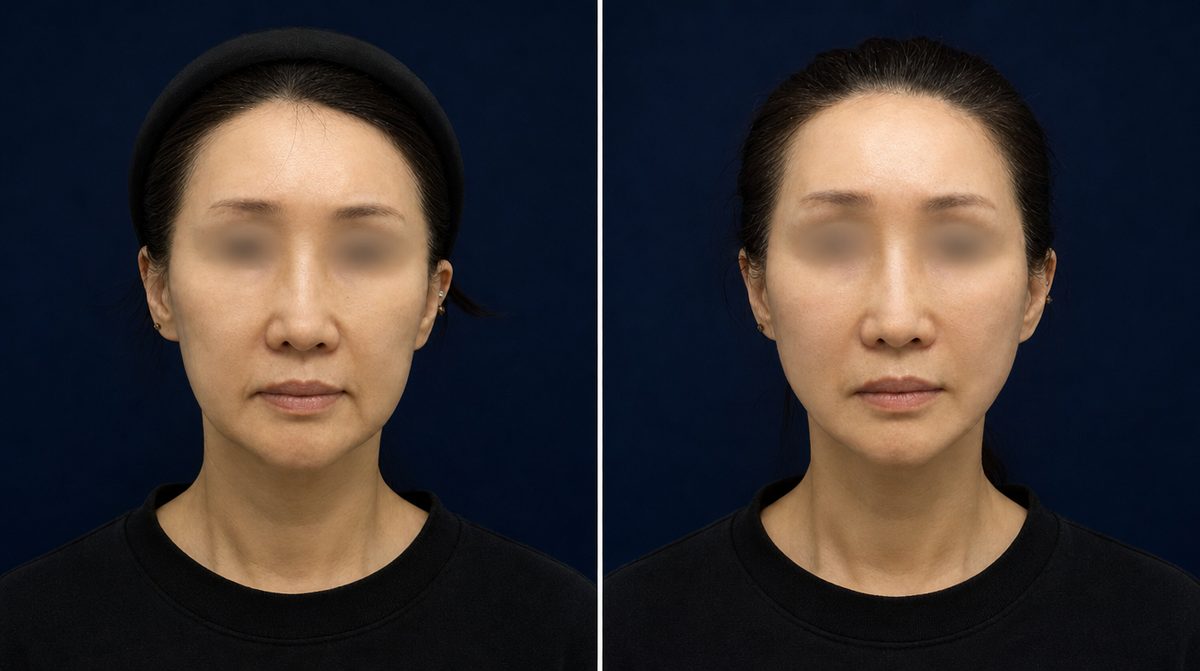
BA_IMAGE_1 Analysis: Mint Thread Lifting — 16 Threads
The first comparison panel shows the patient in a frontal or near-frontal orientation under consistent overhead studio lighting. Comparing the before panel (left) to the after panel (right), several changes are observable:
- Jawline definition: The soft tissue along the mandibular border appears more clearly delineated in the after panel, with reduced heaviness in the jowl area. The transition from cheek to jaw is crisper.
- Midface position: The malar soft tissue appears to sit slightly higher in the after image, which is consistent with a superolateral lifting vector applied during thread placement.
- Nasolabial fold depth: The fold appears somewhat softened in the after panel, which may reflect both the lifting of the midface tissue that contributes to fold formation and any direct thread influence in the perioral zone.
- Lower face contour: The overall silhouette of the lower face appears more V-shaped compared to the before panel, where the soft tissue distribution had a broader, heavier quality.
What makes this case notable is the use of 16 threads. A higher thread count across the midface and lower face allows for a more comprehensive coverage pattern and more distributed tension — which in turn reduces the risk of localized puckering and supports a smoother final contour. The source record confirms 16 threads were used; the exact placement zones per thread are not specified in the record.
Regarding timeline: the source record does not provide a photo interval, so we cannot state how many weeks or months after treatment the after photograph was taken. As general guidance, swelling and early asymmetry typically resolve within the first one to two weeks following thread lifting, with peak results generally visible between four and twelve weeks — but this is general clinical knowledge, not a timeline specific to this patient.
BA_IMAGE_2 Analysis: Thread Lifting + ONDA Combination Case
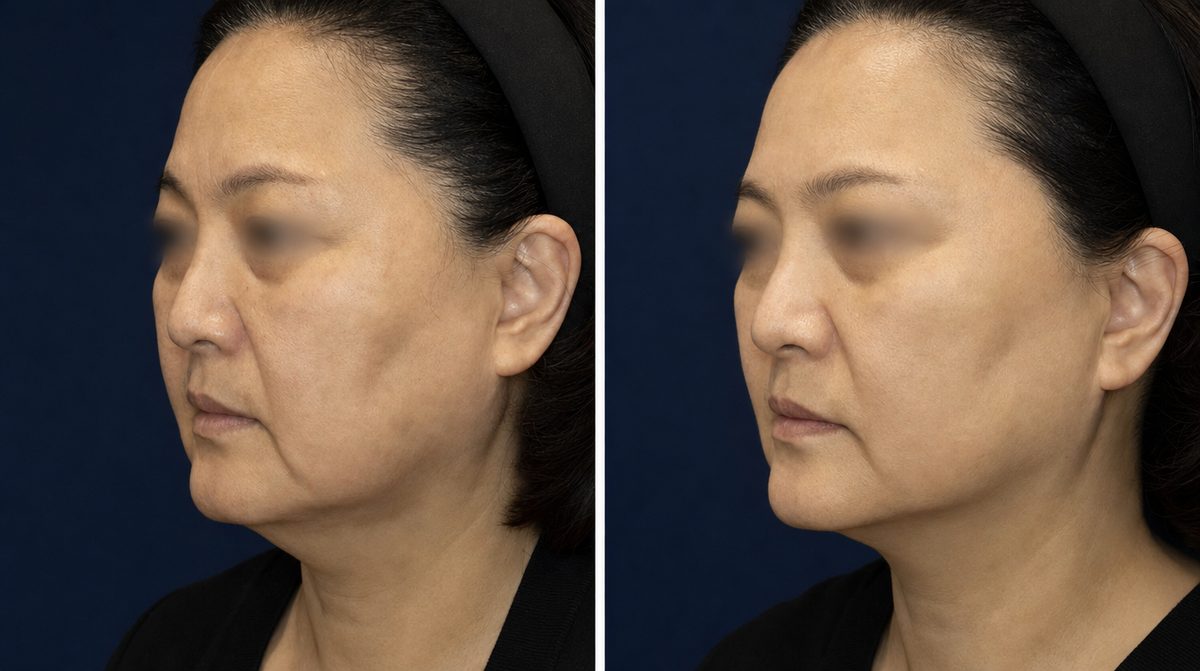
The second comparison panel documents a combination treatment case involving Thread Lifting and ONDA, a microwave-based body and face contouring device. The source record for this specific image identifies the combination protocol.
In this panel, the improvements are visible across both facial contour and submental (under-chin) or lower face definition, depending on the exact frame angle shown. Observable changes include:
- Overall facial contour sharpening: The perimeter of the face in the after panel demonstrates a tighter, more defined outline compared to the before image.
- Skin surface quality: The combination of thread lifting mechanical repositioning and ONDA’s energy-based tissue effects appears to contribute to an improvement in surface quality and firmness that would be less pronounced with either treatment alone.
- Lower face and neck transition: In the after panel, the angle between the lower jaw and neck appears more defined, suggesting a dual effect from the lifting component and ONDA’s influence on submental tissue.
The photographs are framed and lit consistently across both panels, which allows for meaningful side-by-side comparison. As always, photographic documentation is subject to limitations: minor variations in patient position, facial expression, or ambient light can influence the apparent magnitude of any change. The improvements described here are those visible within the constraints of the supplied images.
For additional before and after cases across multiple treatments, visit our Before and After gallery at DR.BAQUO.
What Makes These Thread Lift Results Possible
Results in thread lifting are highly technique-dependent. Unlike energy devices where a machine applies a standardized output, thread lifting outcomes are directly tied to the inserting physician’s planning, anatomical knowledge, and execution. At DR.BAQUO, Dr. Park performs both consultation and treatment personally — every thread insertion is the doctor’s own hand, not a technician’s.
Thread Count, Vector Planning, and Placement Depth
The 16-thread protocol documented in this case reflects a deliberate choice to treat multiple facial zones with overlapping vectors rather than relying on a minimal-thread approach. Higher thread counts allow the physician to:
- Distribute tension more evenly across a wider surface area
- Address multiple anatomical zones in a single session — for example, the zygomatic arch, cheek body, mandibular border, and perioral region
- Reduce the likelihood of focal dimpling or visible thread tract irregularity
Placement depth is equally critical. Threads placed too superficially may create visible ridging; threads placed too deep may fail to engage the relevant tissue layer for lifting. Dr. Park’s approach emphasizes placement within the subcutaneous fat compartment above the SMAS (superficial musculoaponeurotic system) plane, where Mint threads generate effective mechanical traction.
Why Results Vary Between Patients
Thread lifting outcomes differ based on multiple patient-side variables. Patients with moderate tissue laxity and good skin elasticity tend to show more dramatic immediate lifts. Patients with significant skin excess or heavy subcutaneous fat volume may see more modest repositioning. Bone structure, facial fat compartment distribution, and previous treatments all influence outcomes.
This is why the before and after results shown here cannot be generalized as a typical or guaranteed outcome. They represent real results from specific patients under specific conditions.
Combination Treatments That Enhance Outcomes
As shown in the BA_IMAGE_2 case, combining thread lifting with an energy-based modality can enhance both the immediate and longer-term result. Devices that stimulate collagen remodeling or improve skin quality work synergistically with the mechanical repositioning that threads provide.
For patients considering whether thread lifting alone is sufficient for their concerns, or whether it should be paired with skin-tightening technology, our team recommends reviewing our guide to Ultherapy vs Thermage as a reference point for understanding what energy-based lifting options can contribute.
Our comprehensive DR.BAQUO Thread Lift guide and Korean Thread Lift guide provide additional background on how thread selection, protocol design, and clinic experience shape results.
Recovery and What to Expect After Thread Lift Korea
Recovery from thread lifting is one of the primary reasons patients seeking thread lift Korea procedures choose this treatment over surgical alternatives. The procedure is performed without general anesthesia in most clinical settings, and patients typically return to normal activities within a short window — but realistic expectations about the recovery phase are essential.
The Day-by-Day Recovery Progression (General Guidance)
The following is general clinical guidance applicable to thread lifting as a category. The source record for this patient does not specify their personal recovery timeline, and individual experiences vary.
- Immediately after treatment: Mild swelling, slight redness at insertion points, and a sensation of tightness or heaviness in the treated area are commonly reported. Some patients notice subtle dimpling or surface irregularity at thread entry points, which typically resolves as swelling subsides.
- First 48 to 72 hours: Swelling tends to peak and then begin to resolve. Bruising, if present, may become more visible during this window before fading. Pain is generally mild and manageable; the source record does not specify analgesic use for this patient.
- First week (general guidance): Most patients find that swelling decreases substantially by the end of the first week. Many patients return to professional and social activities within three to seven days, though this varies by individual and by how many threads were placed.
- Weeks two through four (general guidance): The skin and tissue settle into the new position as swelling fully resolves. Residual tightness fades, and the result begins to look and feel more natural. This is the phase during which the collagen stimulation process is initiated.
- Month one through three (general guidance): Peak results, incorporating both the mechanical lift and early collagen remodeling, are typically most apparent in this window. Skin texture improvements become more noticeable during this phase.
Before and After Care Instructions
Prior to treatment, patients are generally advised to avoid blood-thinning medications and supplements for a prescribed period before the procedure — specific instructions should be confirmed during consultation. After treatment, patients are typically advised to sleep with their head elevated, avoid vigorous facial massage or manipulation, and limit extreme facial expressions in the immediate recovery period.
Who Is a Good Candidate for Thread Lift in Korea?
Thread lifting addresses a specific category of aging concern, and identifying whether it matches your needs is as important as selecting the right clinic.
Ideal Patient Profile
Patients who tend to see the most meaningful before and after results from thread lifting share some common characteristics:
- Mild to moderate facial sagging, particularly in the midface, jowl area, or along the jawline
- Skin that retains reasonable elasticity — enough to hold a repositioned position without excessive redundancy
- A desire for visible improvement without the commitment of surgical recovery
- Realistic expectations about the degree of change achievable through a minimally invasive approach
Thread lifting is not a substitute for surgical facelift in patients with advanced skin laxity or heavy tissue volume. For those patients, the improvement may be more subtle, and a combination approach or surgical consultation may be more appropriate.
When to Consider Alternatives
Patients with primarily skin texture or tone concerns — rather than sagging — may benefit more from energy-based treatments. Our Ultherapy vs Thermage post discusses the differences between HIFU and radiofrequency lifting modalities, which address tissue from a different mechanism than threads.
Patients with a history of previous thread placement should disclose this during consultation, as existing scar tissue and anchoring tissue changes can influence the safety and planning of subsequent thread procedures.
International Patient Considerations
DR.BAQUO is located directly at Konkuk University Station Exit 1 on Seoul Metro Line 2, making it straightforward to reach from major transit hubs. For international patients planning a Seoul trip around treatment, the clinic’s multilingual staff — fluent in Chinese, Japanese, and English — support communication throughout consultation, treatment, and follow-up. Post-treatment follow-up is also available via LINE for international patients returning home before their final check-in.
Patients traveling from Japan (韓国 糸リフト / 韓国 糸リフト ダウンタイム), Taiwan (韓國埋線拉提), or Mainland China (韩国医美) frequently ask about combining thread lifting with other procedures during a single Seoul visit. Our Signature Program is designed for patients who want a coordinated multi-treatment approach within a structured itinerary.

FAQ — Thread Lift Korea Before and After Questions
Q: What do the before and after photos at DR.BAQUO actually show for thread lifting?
A: The before and after photographs shown in this post document visible changes in jawline definition, midface position, and lower face contour following Mint Thread Lifting with 16 threads. The comparison panels use consistent lighting and orientation, which supports the credibility of the changes shown. However, these photographs represent specific patients under specific conditions, and outcomes vary. They cannot predict any individual’s result.
Q: How many threads were used in the case shown?
A: The source record confirms that 16 Mint threads were used. The specific placement zones per thread are not detailed in the record. Thread count protocols are determined individually based on the patient’s facial anatomy, the degree of laxity present, and the areas targeted for lifting.
Q: How long do thread lift results last?
A: The source record for this patient does not specify a projected or observed duration. As general clinical guidance, results from absorbable thread lifting are temporary, and duration varies with tissue quality, lifestyle, thread type, and the individual treatment plan. The collagen remodeling process that occurs as threads absorb may extend some degree of benefit beyond the thread’s physical presence. Consult with the treating physician for guidance specific to your case.
Q: Is there significant downtime after thread lifting in Korea?
A: The source record does not specify this patient’s recovery experience. As general guidance, temporary swelling or bruising can occur after treatment, and the time needed to resume routine activities varies by the individual and treatment plan. Thread count, placement depth, and individual healing factors all influence recovery. This timeline is general clinical knowledge, not a statement about this patient’s experience.
Q: How much does thread lifting in Korea cost?
A: The source record does not include a price, and we do not publish prices without a current verified price source. Thread lifting costs in Korea vary based on the number of threads, the brand of thread used, the areas treated, any combination treatments included, and clinic-level factors. A consultation at DR.BAQUO — either in person or by inquiry via the clinic’s LINE account — is the accurate way to receive a quote specific to your concerns and anatomy.
Q: What are the risks associated with thread lifting?
A: Thread lifting carries risks that are documented in peer-reviewed literature. A systematic review of thread-lift complications published on PubMed identified risks including infection, visible thread extrusion, dimpling, asymmetry, and motor or sensory nerve effects. A 2025 review of facial thread-lifting complications further characterizes the range of adverse events in the literature. At DR.BAQUO, Dr. Park’s personal involvement in every procedure — combined with MFDS-certified materials and a thorough pre-treatment assessment — is designed to minimize these risks, but they cannot be eliminated entirely. Patients should discuss their individual risk profile during consultation.
Q: Can thread lifting be combined with other treatments?
A: Yes. As shown in the BA_IMAGE_2 case documented in this post, thread lifting can be combined with energy-based devices such as ONDA. Combination approaches may enhance outcomes by addressing tissue laxity through multiple mechanisms simultaneously — mechanical repositioning from threads and collagen remodeling from energy-based devices. Whether a combination protocol is appropriate depends on individual assessment.
Q: What should international patients know about getting a thread lift in Korea?
A: DR.BAQUO is accessible directly from Konkuk University Station Exit 1, simplifying navigation for international visitors. The clinic’s multilingual staff facilitate communication in English, Chinese, and Japanese. Post-treatment follow-up is available via LINE for patients who return to their home country after treatment. For patients planning a visit from Japan (韓国 糸リフト), Taiwan (韓國埋線拉提), or elsewhere, the consultation process can be initiated online before the Seoul trip.
Sources and Medical References
The risk and limitation statements in this post draw from the following peer-reviewed sources, which were supplied as verified references for this article:
- Thread-lift complication systematic review: Sulamanidze M et al., PubMed PMID 33821308 — Systematic review of thread-lift complications. This source supports statements about the documented adverse event profile of thread lifting, including infection, extrusion, and nerve-related effects.
- Evidence-based thread-lift safety review: PubMed PMID 34699439 — Evidence-based safety review of facial thread lifting. This source supports statements about the range of outcomes and the importance of technique and patient selection in minimizing complications.
- 2025 review of facial thread-lifting complications: PubMed PMID 39760325 — 2025 review of facial thread-lifting complications. This is the most recent peer-reviewed review in the supplied sources and supports updated characterization of the adverse event landscape in thread lifting as of 2025.
No statements in this post attribute MFDS or FDA approval to specific products or indications beyond what is documented in the supplied sources. Product brand mentions reflect the source record only.
For further reading on thread lifting at DR.BAQUO, visit our DR.BAQUO Thread Lift guide and Korean Thread Lift guide.
DR.BAQUO — Hanlim Tower 2F, 229 Achasan-ro, Gwangjin-gu, Seoul
Subway: Line 2 Konkuk University Station Exit 1 (direct connection)
Google Maps | LINE: @364kbfyj | global.drbaquo.com
—
DR.BAQUO
Hanlim Tower 2F, 229 Achasan-ro, Gwangjin-gu, Seoul
Line 2 Konkuk University Station Exit 1 (direct connection)
 WhatsApp
 LINE
LINE

 WhatsApp
 LINE
LINE WeChat
 Instagram
 YouTube
 TikTok
 KakaoTalk
