
If you’ve been searching for skin booster before and after Korea results that reflect real, unfiltered outcomes — this post is exactly what you need. At DR.BAQUO, skin booster treatments using Gouri PCL and HILO WAVE have become two of our most requested procedures for patients seeking measurable skin rejuvenation without surgery. The demand for water glow injection Korea experiences has grown significantly, and for good reason: these treatments produce visible, photographic-level changes in skin texture, hydration, and overall luminosity when performed with precision.
In this post, we’re sharing two real before and after cases from our August 2026 treatment archive. The first case features a combined Gouri, Thread Lifting, and Juvederm protocol. The second focuses on under-eye rejuvenation using HILO WAVE alongside Juvederm filler. Both cases were performed personally by Dr. Park, and both demonstrate what thoughtful combination aesthetic medicine looks like when carried out by an experienced hand.
Whether you’re planning a trip to Seoul for skin treatments or simply researching your options, these real results offer the transparency you deserve.
What Is a Skin Booster? — How Gouri and HILO WAVE Work
A skin booster is an injectable treatment designed to improve skin quality from within — addressing hydration, texture, fine lines, and overall radiance rather than simply adding volume or repositioning structures. Unlike traditional dermal fillers that primarily reshape or volumize specific areas, skin boosters disperse within the dermis to trigger biological responses that lead to long-term skin improvement.
Gouri PCL — Collagen Stimulation at Scale
Gouri is one of the most innovative skin booster formulations to emerge from Korean aesthetic medicine. It contains polycaprolactone (PCL), a fully biocompatible and biodegradable biopolymer that acts as a collagen stimulator. When injected into the face using a whole-face spreading technique, Gouri diffuses evenly through the subcutaneous tissue, stimulating fibroblasts to produce new collagen over a period of weeks to months.
What distinguishes Gouri from older PCL-based products is its liquid form at room temperature — it flows naturally into the tissue without the clumping or nodule risk associated with some other biostimulators. The result is a gradual but meaningful improvement in skin firmness, elasticity, and surface quality. Patients typically notice that the skin begins to feel “tighter from the inside” starting around four to six weeks after treatment.
Gouri is approved by Korea’s MFDS (Ministry of Food and Drug Safety) and has also received CE marking in Europe. Its safety profile is well-established, with minimal risk of granuloma formation and no reported systemic adverse events in properly selected patients.
HILO WAVE — Targeted Hydration and Rejuvenation
HILO WAVE is a hyaluronic acid-based skin booster delivered through a cross-linked HA formulation specifically engineered for superficial dermal placement. Unlike standard hyaluronic acid fillers, HILO WAVE is not designed to add volume — it is designed to flood the dermis with moisture-binding HA molecules, improving skin hydration, softness, and surface texture.
The “WAVE” application technique uses micro-injections across a target zone — most commonly the under-eye area, cheeks, forehead, and neck — to create a micro-depot network of hydrating HA throughout the treatment area. This technique is particularly effective for the delicate under-eye zone, where skin is thin and prone to crepiness, fine lines, and a dehydrated appearance.
Why These Treatments Produce Visible Before/After Differences
The combination of collagen stimulation (Gouri) and targeted dermal hydration (HILO WAVE) addresses skin quality on two distinct biological levels. Gouri works on the structural scaffold of the skin over weeks; HILO WAVE delivers immediate and sustained surface hydration. Together, they create results that are both photographically visible and tactilely noticeable to the patient.
All equipment and products used at DR.BAQUO are MFDS-certified, with visible certification displays in the treatment rooms for patient transparency.
 WhatsApp
 LINE
LINE KakaoTalk
Skin Booster Before and After — Case Analysis
At DR.BAQUO, we document results systematically using standardized lighting, consistent camera distance, and neutral backgrounds. This matters because credible before and after photography requires identical conditions — any change in lighting angle or skin prep can artificially inflate or diminish the appearance of results. What you see in our images reflects genuine tissue change, not photographic manipulation.
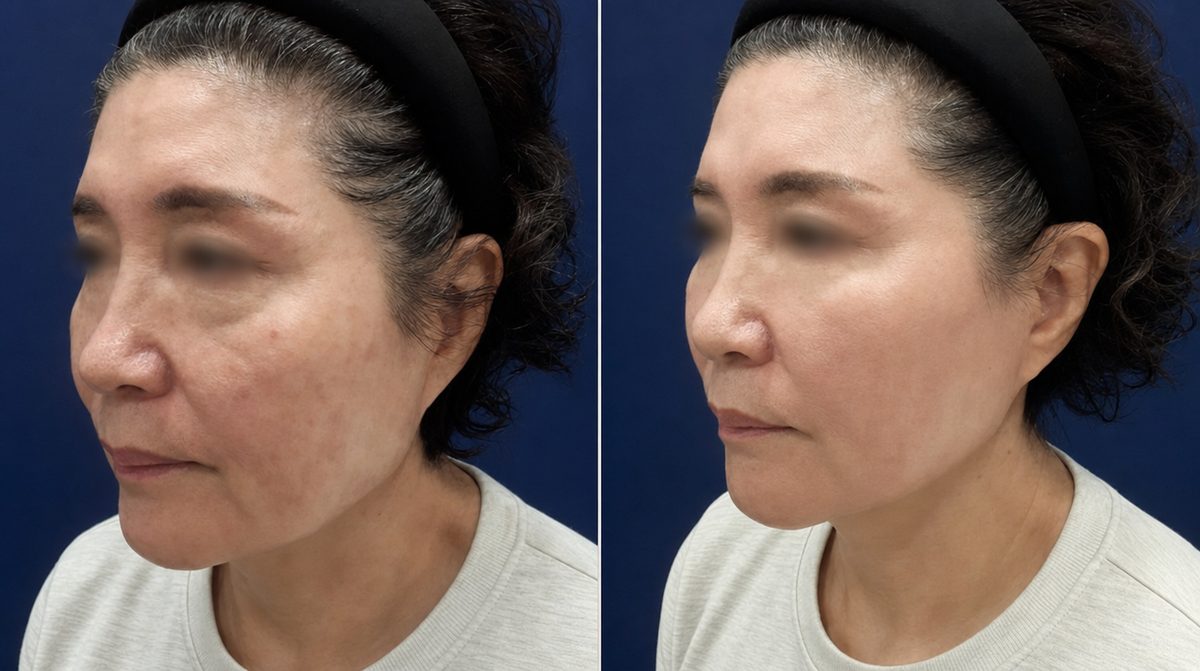
Case 1: Gouri + Thread Lifting + Juvederm — Full Facial Rejuvenation
Patient profile: Female patient, estimated mid-30s to early 40s. Primary concerns included skin laxity along the mid-face and jawline, loss of cheek volume, visible nasolabial fold deepening, and generalized skin dullness with reduced elasticity.
What the before image shows: The left side of the image reveals mild-to-moderate volume deflation in the malar (cheek) area, with the nasolabial folds casting a visible shadow consistent with tissue descent. Skin surface appears relatively flat in light reflection, suggesting reduced dermal hydration and early collagen thinning. Jawline definition is softened by early jowling.
What the after image shows: The right side demonstrates a visible lift in the mid-face contour — the malar area appears fuller and more projected, and the nasolabial fold shadow has softened meaningfully. Skin surface quality has improved, with a more even light reflection across the cheeks and forehead consistent with improved hydration and early collagen response from the Gouri component.
The key to this result was the layered combination approach. Thread lifting repositioned descended tissue mechanically, providing immediate structural lift. Juvederm restored volume to the malar and nasolabial region with precise placement. Gouri PCL was applied across the whole face to initiate the collagen cascade that will continue improving skin quality over the next three to six months. Each treatment layer addressed a different anatomical concern, which is why the overall result appears balanced rather than “done.”
Timeline: Patients in this protocol typically experience initial lift and volume correction within 48 to 72 hours. The Gouri collagen stimulation begins becoming visible at four to six weeks and continues progressing through the three-month mark. Peak combined results are typically seen at the three-month follow-up visit.
Sessions: Gouri is typically performed in one to two sessions. Thread lifting and Juvederm are single-session procedures that can be combined on the same day with appropriate treatment sequencing.
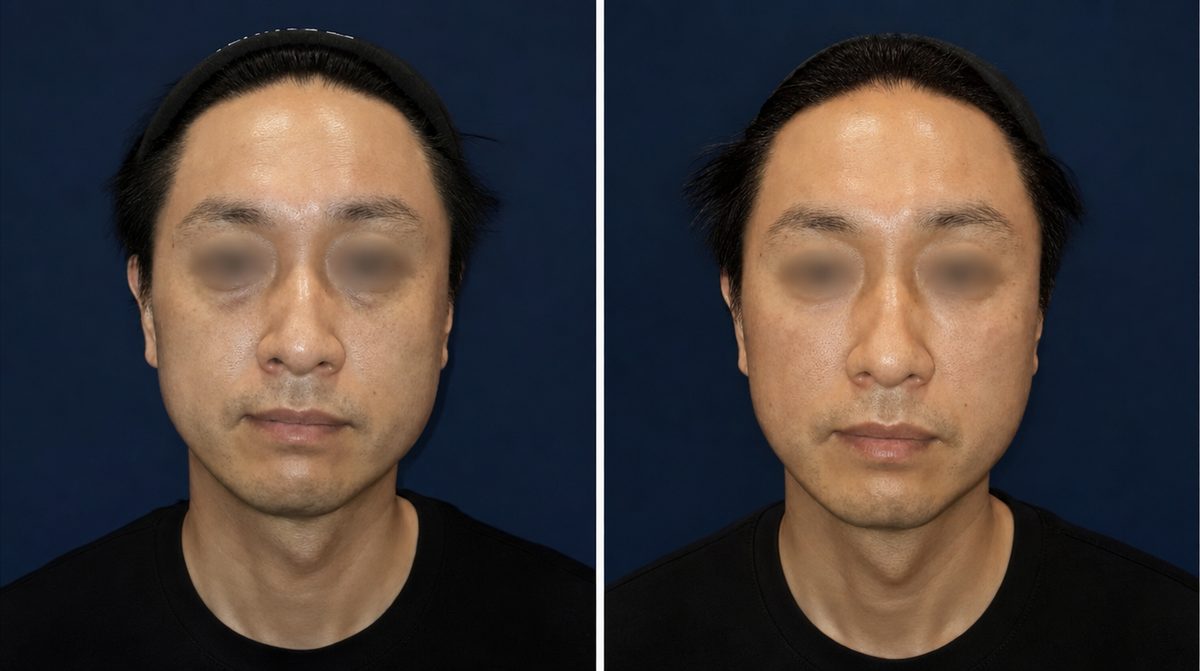
Case 2: Under-Eye HILO WAVE + Juvederm — Tear Trough and Under-Eye Rejuvenation
Patient profile: Female patient, estimated late 20s to mid-30s. Primary concern was a hollow, shadowed appearance under the eyes — commonly described as “tired-looking eyes” — along with fine crepey texture in the infraorbital skin and early tear trough formation.
What the before image shows: The left side of the image reveals a visible shadowing beneath the lower lids, particularly in the medial tear trough region. The skin surface in the infraorbital area appears slightly textured and lacks the smooth, hydrated appearance characteristic of healthy periorbital skin. The transition from the lower eyelid to the cheek is abrupt and shadowed rather than smooth and gradual.
What the after image shows: The right side shows a meaningful improvement in the tear trough shadow — the infraorbital hollow has been softened, and the transition zone between lower lid and cheek appears more gradual and naturally integrated. The skin surface in the under-eye area looks noticeably smoother and more reflective, consistent with improved dermal hydration from the HILO WAVE treatment. The overall effect is a more rested and refreshed periorbital appearance.
The key to this result was the precision required in the under-eye zone. The infraorbital area is one of the most technically demanding treatment sites in facial aesthetics — the skin is thin, vascular anatomy is variable, and the margin between natural-looking correction and overcorrection is narrow. Juvederm was placed deep along the orbital rim to restore volume and reduce shadowing, while HILO WAVE micro-injections addressed the superficial skin quality layer independently. Dr. Park performs both consultation and treatment personally — every injection in this delicate zone is placed by the doctor’s own hand, not delegated to an assistant.
Timeline: Patients typically notice initial improvement in the tear trough appearance within three to five days as swelling subsides. HILO WAVE skin quality improvements become apparent over the following two to four weeks. Results from hyaluronic acid filler in the tear trough typically last nine to twelve months, while HILO WAVE hydration effects are generally maintained for six to nine months with a single session.
What makes this case interesting is that the improvement in skin texture — the smoothing of fine crepey lines in the infraorbital skin — is something patients often don’t anticipate before the treatment but consistently report as their favorite part of the outcome. The HILO WAVE component addresses a concern that filler alone cannot resolve, which is why the combination approach produces results that are more complete than either treatment individually.
What Makes These Results Possible
DR.BAQUO’s Approach to Skin Booster Treatments
At DR.BAQUO, we approach skin booster treatments with a focus on natural results — specifically, results that look like the best version of the patient rather than an altered version. This philosophy shapes every aspect of how we plan and execute combination protocols.
The starting point is always a detailed consultation in which Dr. Park personally assesses the patient’s skin quality, volume distribution, tissue laxity, and facial proportions. This assessment determines not just which treatments are appropriate, but in what sequence they should be performed and how they interact with each other. Gouri PCL, for example, produces optimal results when placed after any threading procedure rather than before, because the tissue disruption from threading can affect how Gouri distributes.
Product and Equipment Specifics That Matter
Not all skin boosters are equivalent. At DR.BAQUO, we use only MFDS-certified formulations with documented clinical data. Gouri’s liquid PCL technology represents a genuine advance over earlier generation biostimulators because of its even tissue distribution and predictable collagen yield. HILO WAVE’s cross-linked HA formulation is specifically engineered for the superficial dermis — using a standard HA filler in the same way would produce a different, less optimal result.
The injection technique is equally important. Dr. Park uses a customized micro-injection mapping approach for HILO WAVE, placing depots at precise depth intervals to create the most homogeneous hydration network possible. For Gouri, the whole-face spreading technique is executed using a defined injection point map developed through extensive clinical experience.
Combination Treatments That Enhance Outcomes
The cases shown in this post illustrate a core principle of our practice: combination treatments deliver results that are categorically superior to single treatments when the combination is thoughtfully designed.
Some of the most effective combinations we use alongside skin boosters include:
- Gouri + Thread Lifting: The mechanical lift from threads and the biostimulatory collagen cascade from Gouri address tissue position and skin quality simultaneously — a combination that anti-aging single treatments cannot replicate
- HILO WAVE + Juvederm (tear trough): Volume restoration and dermal hydration working at different anatomical depths for a more complete under-eye result
- Gouri + Rejuran: For patients with significant photoaging, adding Rejuran (PDRN) alongside Gouri amplifies the regenerative signal, often producing faster and more pronounced texture improvement
For patients interested in exploring these options, our post on [combination anti-aging protocols at DR.BAQUO] provides detailed information on how layered treatments are sequenced.
Recovery and What to Expect After a Skin Booster Treatment
One of the most common questions we receive from prospective patients — particularly those planning a skin rejuvenation Seoul experience from abroad — is about recovery. The honest answer is that skin booster treatments are among the most forgiving aesthetic procedures in terms of social downtime, but there are specific things to be aware of at each stage.
Day 1 — Immediately Post-Treatment
Immediately after treatment, patients will notice small raised bumps at each injection point (micro-papules). These are normal and expected. For HILO WAVE, these papules typically flatten within two to six hours. For Gouri, the spreading effect means the initial papules may appear more diffuse. Some patients experience mild redness across the treated zone — this generally resolves within four to twelve hours. We recommend avoiding strenuous exercise, saunas, and alcohol on the day of treatment.
Week 1 — Initial Response
By day three to five, most injection marks have resolved completely. Patients sometimes report a mild “tightness” sensation in the treated area, particularly after Gouri — this is a positive sign of early tissue response. If Juvederm was included in the treatment, some mild bruising is possible, particularly in the under-eye zone, and can last up to seven to ten days. Arnica-based topicals can be helpful during this window.
We recommend avoiding facial massages, microneedling, or any ablative treatments for at least two weeks post-treatment.
Month 1 — Early Results Emerge
At the one-month mark, most patients begin noticing that their skin feels firmer and appears more luminous than it did even before treatment. This is when the early-phase collagen stimulation from Gouri becomes perceptible. Patients often comment that their makeup applies more smoothly — a reflection of improved surface texture.
Month 3 — Peak Results
Three months post-treatment represents the peak of Gouri’s collagen stimulation effect and the full expression of the combined treatment protocol. This is our standard follow-up timepoint, and it’s when we photograph results for documentation. The improvement in skin firmness, texture, and overall quality that’s visible in our before and after photography reflects the three-month outcome — not an immediate post-procedure photograph.
Aftercare Instructions
Key aftercare points we provide to all patients:
- Avoid direct sun exposure without SPF 50+ for four weeks post-treatment
- Use gentle, non-active skincare for the first two weeks (no retinol, no AHAs/BHAs)
- Stay well hydrated — this matters particularly for HILO WAVE outcomes
- Sleep on your back for the first three days if possible
- Return for a follow-up assessment at four to six weeks
For international patients, we provide post-treatment follow-up support via LINE (@364kbfyj), so you’re never without access to Dr. Park’s team even after returning home.
Who Is a Good Candidate for Skin Booster Treatments?
Ideal Patient Profile
Skin booster treatments are broadly appropriate for a wide range of patients, but they produce the most dramatic before and after results in individuals who present with:
- Early to moderate skin laxity — patients with skin that has begun to lose elasticity but has not undergone significant tissue descent
- Dehydrated or dull skin — those whose skin appears lackluster, uneven, or “tired” despite good skincare habits
- Fine lines and early crepiness — particularly in the periorbital, perioral, and neck areas where skin is thinner
- Volume deflation with good skin quality — patients who have lost facial volume but still have reasonable skin elasticity respond exceptionally well to Gouri combined with filler
- Preventive aging patients — patients in their late 20s to mid-30s who want to proactively support collagen density before visible aging accelerates
Concerns These Treatments Address Best
- Overall skin radiance and glass-skin effect
- Fine surface texture and enlarged pores
- Under-eye hollowing and infraorbital shadowing
- Nasolabial fold softening (when combined with filler)
- Mid-face volume restoration and firmness
- Neck skin quality improvement
When to Consider Alternatives
Patients with significant structural tissue descent — deep jowling, pronounced marionette lines, or severe volume loss — may require a more surgical or intensive approach before skin booster treatments can deliver their full effect. During your consultation, Dr. Park will be direct about what combination of treatments will address your specific concerns most effectively.
Skin boosters are also not the primary treatment for deeply pigmented concerns like melasma or dermal hyperpigmentation — these require a dedicated pigmentation protocol.
International Patient Considerations
DR.BAQUO is located directly at Konkuk Station Exit 1 (Line 2, Konkuk University Station), making it one of the most accessible aesthetic clinics in Seoul for visitors using public transportation. The clinic is located at Hanlim Tower 2F, 229 Achasan-ro, Gwangjin-gu — a 10-minute ride from Hongdae and 15 minutes from Gangnam.
Our multilingual staff speak Chinese, Japanese, and English, ensuring smooth communication throughout the consultation, treatment, and aftercare process. For patients planning a medical aesthetic trip to Korea, we recommend scheduling a virtual consultation in advance via our website at global.drbaquo.com so that your treatment plan can be finalized before arrival, maximizing your time in Seoul.

FAQ — Skin Booster Before and After Questions
Q: How visible are skin booster before and after results after just one session?
A: This depends on the specific treatment. HILO WAVE produces noticeable improvement in skin smoothness and hydration that becomes apparent within two to four weeks of a single session. Gouri PCL produces more progressive results — the collagen stimulation effect is cumulative, and peak results are typically seen at the three-month mark. Patients who combine Gouri with filler or threads typically see more immediate structural changes alongside the slower-developing skin quality improvements. Most patients describe their one-session Gouri before and after as clearly visible at the three-month follow-up photo.
Q: How long do skin booster results last in Korea clinics like DR.BAQUO?
A: HILO WAVE results for skin hydration and texture typically last six to nine months with a single treatment session. Gouri PCL collagen stimulation results are generally maintained for twelve to eighteen months, though individual variation applies based on age, lifestyle, and baseline skin condition. We typically recommend a maintenance session of Gouri every twelve months and HILO WAVE every six to nine months for sustained results.
Q: Is Gouri better than traditional skin boosters like Juvederm Volite or Restylane Skinboosters?
A: They work through different mechanisms and are not direct substitutes. Gouri stimulates your own collagen production through PCL biostimulation — the result is a structural improvement in skin firmness and elasticity. Traditional HA skin boosters like Juvederm Volite or Restylane Skinboosters deliver external hyaluronic acid to improve hydration and plumpness. Both have value; the choice depends on what the patient’s skin needs most. At DR.BAQUO, we often combine both approaches — using Gouri for structural collagen support and HILO WAVE for surface hydration.
Q: Does the skin booster treatment hurt? What does the experience feel like?
A: Discomfort is manageable for most patients. We apply topical anesthetic cream for 20 to 30 minutes prior to treatment, which significantly reduces injection sensation. Most patients describe the HILO WAVE micro-injections as a series of small pinpricks — brief and tolerable. Gouri injections are typically less uncomfortable than traditional needle-based treatments because fewer, more strategic injection points are used. Patients with very low pain tolerance can request additional comfort measures during their consultation.
Q: Can international patients get a skin booster treatment on their first day in Seoul?
A: In most cases, yes — provided a pre-consultation has been completed virtually in advance and the patient has no contraindications identified during that review. We recommend scheduling your treatment for day two or three of your Seoul trip to allow time for any initial swelling or injection marks to resolve before any important events. This also gives you time to meet Dr. Park in person before committing to the treatment plan.
Q: What is the cost range for skin booster treatments in Korea at DR.BAQUO?
A: Pricing varies depending on the specific treatment combination, areas treated, and products used. Single-session Gouri treatment is generally more affordable in Seoul compared to equivalent treatments in the US, UK, or Australia due to favorable exchange rates and direct import relationships. We recommend requesting a personalized quote via our website or LINE consultation (@364kbfyj), as combination protocols are priced as packages rather than individual line items at our clinic.
Q: How many sessions of HILO WAVE are needed to see results like those shown in the before and after photos?
A: The under-eye HILO WAVE case shown in this post represents results from a single combined session (HILO WAVE + Juvederm). For patients with more pronounced skin textural concerns or significant dehydration, two sessions spaced four to six weeks apart may be recommended. The initial session produces the most significant improvement; subsequent sessions refine and extend the results. During your consultation, Dr. Park will review your under-eye anatomy and recommend the minimum number of sessions needed to achieve your target outcome.
Q: Are skin booster results in Korea actually better than getting the same treatment elsewhere?
A: The quality of results depends primarily on the practitioner’s skill and product authenticity rather than geography. That said, Korea’s aesthetic medicine ecosystem offers specific advantages: MFDS regulation ensures product authenticity, practitioners have typically performed high volumes of these treatments, and combination protocols are more routinely designed and executed here. At DR.BAQUO, Dr. Park’s personal involvement in every treatment — from first injection to last — is the primary differentiator. You are not receiving care from a rotating roster of nurses or assistants.
DR.BAQUO
Hanlim Tower 2F, 229 Achasan-ro, Gwangjin-gu, Seoul
Line 2 Konkuk University Station Exit 1 (direct connection)
 WhatsApp
 LINE
LINE
 WhatsApp
 LINE
LINE WeChat
 Instagram
 YouTube
 TikTok
 KakaoTalk
