
Hollow temples treatment results from DR.BAQUO Seoul — two real patient cases using Gouri PCL collagen stimulator and HILO WAVE skin booster, with detailed before and after photo analysis.
Introduction: Why Hollow Temples Are One of the Most Searched Facial Concerns in Asia
Hollow temples treatment is one of the fastest-growing requests at aesthetic medicine clinics across Seoul — and for good reason. The temporal region sits at the outer frame of the face, and when volume or skin quality diminishes in this area, it creates a skeletal appearance that can make the entire upper face look drawn, aged, or fatigued even in people who are otherwise healthy.
At DR.BAQUO, we see a wide range of patients who come in specifically asking about the sunken area at the sides of the forehead. Some describe it as a shadow they notice in photographs. Others feel that the overall oval shape of their face has changed — becoming more angular or boxy at the temple — and want to restore the gentle, smooth curve that connects the outer brow to the cheekbone. Many patients also search for “temple filler before and after” — though as this post will clarify, filler is only one of several approaches, and it is not what was used in either case shown here.
In this post, we present two real patient cases treated at DR.BAQUO using two distinct protocols: Gouri, a liquid PCL-based collagen stimulator, applied to the temples; and HILO WAVE, a premium hyaluronic acid skin booster, applied to the temples and front cheeks. These are not volume-filling procedures. Instead, they work through skin quality improvement and gradual collagen stimulation. Understanding this distinction is important before reviewing the photographs.
Quick Answer — What Do These Photographs Show?
The before-and-after photographs from DR.BAQUO show visible improvement in the texture, luminosity, and apparent fullness of the temple region following treatment with Gouri (Case 1) and HILO WAVE on the temples and front cheeks (Case 2). In both cases, the skin surface appears smoother and the hollowed shadow appears less pronounced in the after photographs. Outcomes vary significantly between individuals depending on skin condition, age-related volume loss, bone structure, and other factors. The photographs represent individual results and should not be interpreted as a guarantee.
What Is Hollow Temple Treatment? — How It Works
Hollow temple treatment refers to a category of aesthetic procedures designed to address the concave appearance of the temporal fossa — the anatomical depression at the side of the forehead, bordered by the outer brow, the hairline, and the upper cheekbone. This hollowing can occur for several reasons: subcutaneous fat loss associated with natural aging, weight fluctuation, bone resorption over time, or in some cases, structural predisposition related to facial anatomy.
The key principle behind hollow temples treatment is restoring the visual continuity of the upper face — creating a smooth, gently rounded curve from the outer brow down toward the zygomatic arch, rather than an abrupt angular depression. Approaches to achieving this vary considerably.
Approach 1: Gouri — Liquid PCL Collagen Stimulator
Gouri is a next-generation injectable treatment classified as a biostimulator. It does not add volume in the way a traditional filler does. Instead, it uses polycaprolactone (PCL), a biocompatible polymer, in a liquid dispersion that distributes evenly through the skin layer after injection. Over the following weeks and months, the PCL particles act as a scaffold that stimulates the body’s own fibroblasts to produce new collagen. The result is gradual — patients typically notice progressive improvement in skin firmness, elasticity, and surface quality rather than an immediate volumetric change.
For the temple area specifically, this collagen stimulation can reduce the sunken appearance by improving the structure of the skin and soft tissue from within. For more detail on how Gouri produces these results across different areas, see our Gouri Before and After case gallery.
Approach 2: HILO WAVE — Premium HA Skin Booster
HILO WAVE is a hyaluronic acid-based skin booster — it is not a volumizing filler. It works by delivering highly hydrophilic HA molecules into the mid-dermis, where they attract and retain moisture, stimulate the local skin environment, and improve overall skin quality. In the context of hollow temple treatment, HILO WAVE improves the skin’s surface texture and luminosity, which can reduce the appearance of shadowing in the temporal hollow. When applied in combination with the front cheeks, as in Case 2, it creates a more cohesive improvement in the overall upper face aesthetic. Our full HILO WAVE Before and After post shows results from multiple areas.
Why These Approaches Differ from Temple Filler
Traditional temple filler — most commonly hyaluronic acid (HA) filler or calcium hydroxylapatite (CaHA) injected in larger volumes — is a separate category of treatment. It provides more immediate volumetric correction and is appropriate when the primary concern is significant structural volume loss. Neither of the cases shown in this post used volume-filling products. We mention filler here only as context for patients who are researching their options. For patients who may benefit from volume restoration alongside skin quality treatment, a consultation is the appropriate next step. See our DR.BAQUO Filler page for more information on that approach.
Regarding safety profile: the US FDA provides publicly available guidance on the risks associated with dermal fillers as a category of soft tissue injectables. General risks include bruising, swelling, asymmetry, infection, and the rare but serious risk of vascular occlusion. These risks apply to injectable procedures broadly, and patients should discuss their individual risk profile with their treating physician. DR.BAQUO’s all-equipment carries MFDS certification, with visible certification displays in the clinic.
 WhatsApp
 LINE
 KakaoTalk
Hollow Temple Treatment Before and After — Case Analysis
At DR.BAQUO, before and after photography is taken under consistent clinic lighting to minimize the effect of shadows and ambient variation. That said, it is important to acknowledge that photographs cannot fully eliminate all variables — subtle differences in head positioning, facial expression, or camera distance between sessions can affect how a result appears. We flag these limitations openly so patients can evaluate the images with appropriate critical thinking.
Case 1: Gouri on the Temples
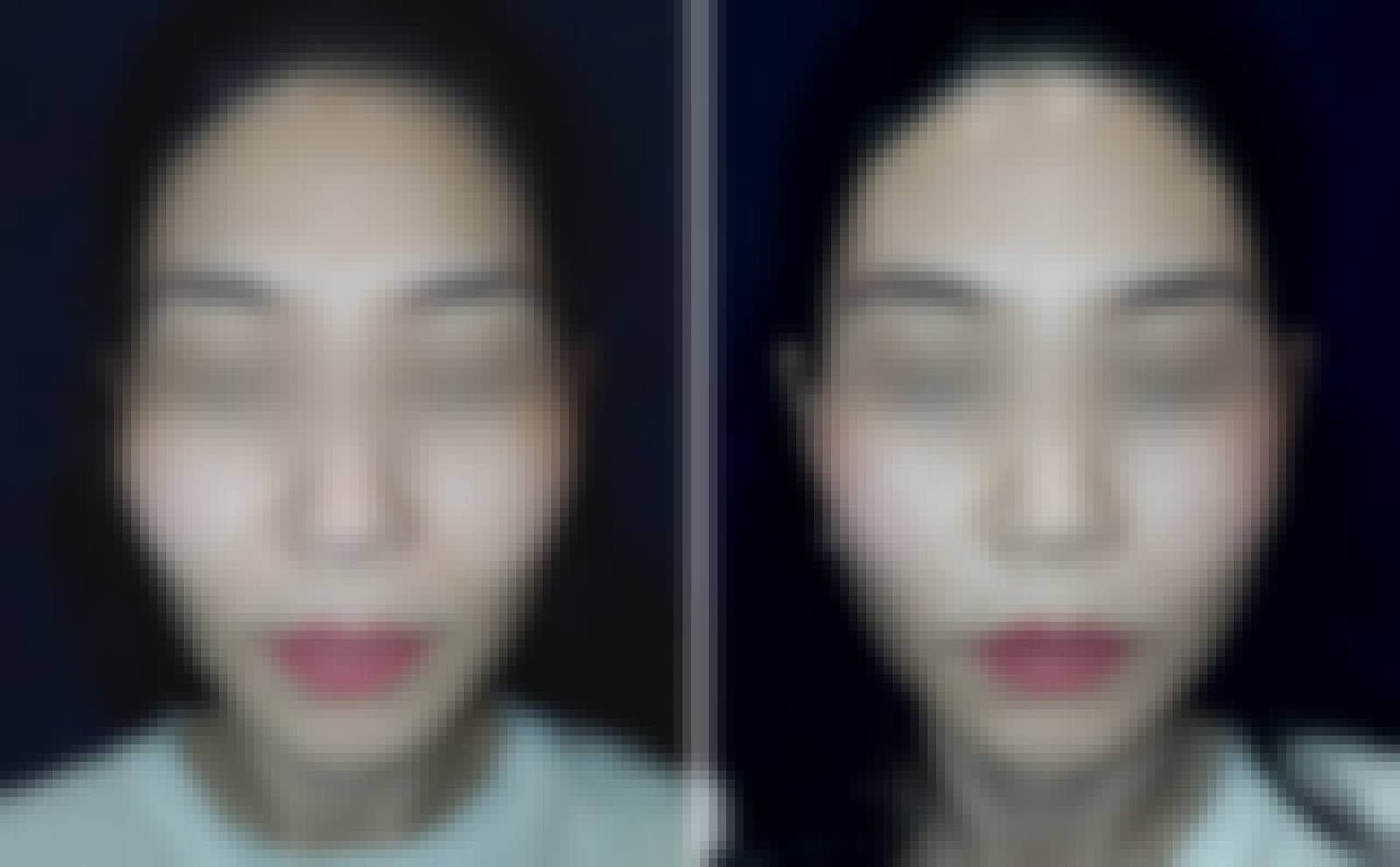
The first before-and-after image shows a patient who received Gouri — the liquid PCL collagen stimulator — applied specifically to the temple area. In the before photograph, the temporal region displays a noticeable concavity along the outer forehead and into the area above the zygomatic arch. The skin in this zone appears comparatively dull, with a shadow cast by the depth of the hollow that makes the mid-face appear disproportionately prominent.
In the after photograph, several changes are visible:
- The shadow at the lateral forehead and temporal hollow appears notably reduced
- The skin surface in the temple area has a visibly smoother, more even texture
- The overall contour of the upper face appears more continuous — the brow-to-cheek line reads as a gentler curve rather than an abrupt angle
- The skin tone in the treated zone appears brighter and more uniform, consistent with the collagen stimulation and tissue remodeling that Gouri produces over time
What makes this case interesting is that the improvement is not the result of volume addition — there is no visible puffiness or artificial-looking fill. Instead, the change reads as a natural improvement in skin quality and soft tissue structure. This is characteristic of how Gouri works: through gradual biostimulation rather than immediate volumetric displacement.
The key to this result was the careful placement of Gouri within the temple’s soft tissue layer to ensure even distribution of the PCL particles. Dr. Park performs both consultation and treatment personally — every injection is the doctor’s own hand — which at DR.BAQUO means the same physician who assesses the patient’s anatomy is the one executing the treatment.
The source record for this case does not specify the patient’s age, the volume used, the number of sessions, or the interval between photographs. As general guidance applicable to Gouri treatments broadly (not specific to this patient), collagen stimulation typically progresses over several weeks to months following treatment, with many patients and practitioners noting that continued improvement can occur for a prolonged period post-treatment.
Case 2: HILO WAVE on the Temples and Front Cheeks
The second before-and-after image shows a patient who received HILO WAVE — the premium hyaluronic acid skin booster — applied to the temples and the front cheeks. This case demonstrates a broader upper-face treatment zone than Case 1, with the goal of improving skin quality across a more expansive region.
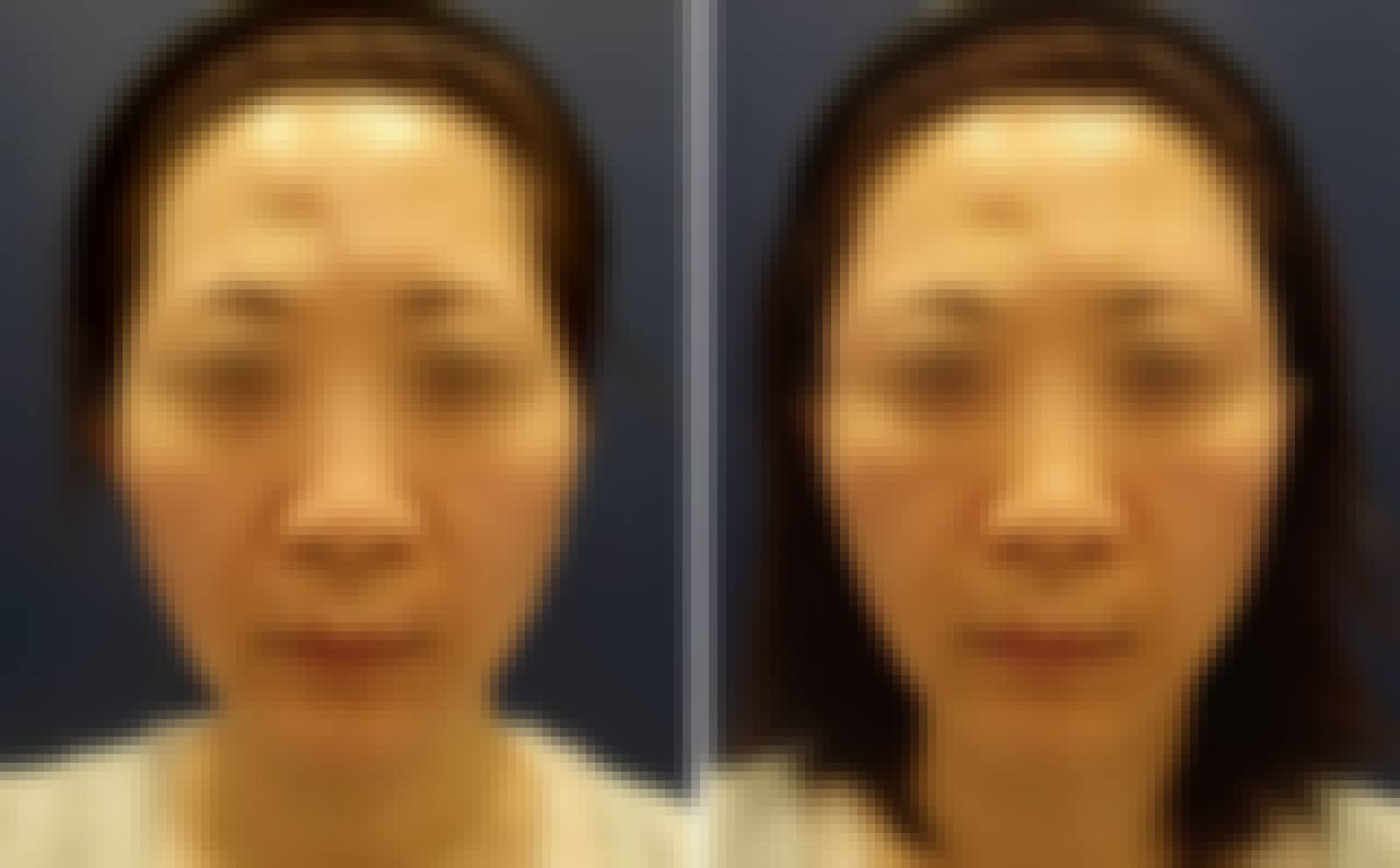
In the before photograph, the temple area shows a degree of hollowing with some surface irregularity, while the front cheek area displays skin that appears comparatively dull with reduced luminosity and surface smoothness.
In the after photograph, the following changes are visible:
- The temple area shows improved skin surface quality, with the hollow appearing less pronounced — likely attributable to improved skin turgor and hydration from the HA-based booster
- The front cheek area appears notably brighter and more luminous, with improved skin texture visible even in a standard photography setting
- Overall facial skin tone appears more even across the treated zones
- The mid-face area reads as more “awake” and refreshed in the after image — a quality that patients frequently describe when discussing their goals before a skin booster consultation
What makes this case instructive is the combination of areas treated. The temples and front cheeks share an anatomical relationship in the upper face, and treating both together can create a more harmonious result than addressing either zone in isolation. See our DR.BAQUO Skin Booster page for more on how we approach multi-zone skin booster treatment planning.
The source record for this case does not specify the patient’s age, the product volume used, the number of sessions, or the interval between the before and after photographs. As general guidance, HA-based skin boosters typically produce visible improvements in skin hydration and luminosity within a shorter timeframe than collagen biostimulators, as their mechanism does not rely on the body’s collagen remodeling process.
What Makes These Results Possible — DR.BAQUO’s Approach
Achieving consistently meaningful hollow temple treatment results requires more than simply selecting the right product. At DR.BAQUO, we approach temple treatments with a focus on natural results — improvements that enhance the face’s own structure rather than superimposing an artificial contour.
Physician-Led Injection Technique
Dr. Park performs both consultation and treatment personally — every injection, every product placement is the doctor’s own hand. This matters in the temple area more than almost anywhere else on the face. The temporal fossa contains significant vascular and neurological structures, including branches of the temporal artery. Precise, anatomy-aware injection technique is essential for both safety and aesthetic outcomes. A treating physician who has personally assessed the patient’s skin thickness, bone structure, and tissue quality is better positioned to make micro-decisions during injection than one working from a prior consultation note alone.
Product Selection: Matching the Mechanism to the Concern
The two cases shown here used two very different product types, and this reflects our approach to individualized treatment planning. Gouri was selected in Case 1 because the primary goal was long-term structural improvement through collagen regeneration — an appropriate choice when the concern has a tissue-quality component alongside the hollow appearance. HILO WAVE was selected in Case 2 to address a broader zone of skin quality concern that extended into the front cheeks, where its hydration and skin-environment benefits could be applied across a larger surface area.
Neither case used traditional volume filler, and we want to be transparent about that. Volume filler remains a valid option for patients with significant structural temporal volume loss, but it carries different risk and recovery profiles and requires its own clinical assessment. Patients who are researching korean temple filler and arrive at DR.BAQUO will receive a thorough explanation of all available approaches and a recommendation based on their individual anatomy.
Combination Treatment Possibilities
For patients whose temporal hollowing is part of a broader facial aging or volume-loss pattern, combination treatments can significantly enhance overall outcomes. Common combination approaches at DR.BAQUO include pairing a biostimulator with a skin booster in sequential sessions, or combining temple treatment with cheek or jawline treatment as part of our Signature Program. The specific combination appropriate for each patient is determined entirely through individual consultation.
All Equipment MFDS-Certified
All equipment and injectables used at DR.BAQUO carry MFDS certification, with visible certification displays throughout the clinic. Patients who wish to verify the certification status of any product used in their treatment are welcome to ask at any point during their visit.
Recovery and What to Expect After Hollow Temple Treatment
Understanding the realistic post-treatment experience is essential for planning — particularly for international patients who may be visiting Seoul from abroad with a defined return timeline.
The source records for the two cases in this post do not specify each patient’s individual recovery experience. The following recovery guidance represents general information that applies broadly to injectable skin booster and collagen biostimulator treatments; it should not be interpreted as a guarantee of any individual patient’s experience.
General Recovery Guidance for Injectable Skin Treatments
Immediately after treatment:
Patients typically notice mild redness, swelling, or pinpoint marks at injection sites. In the temple area specifically, some bruising is possible due to the vascular nature of the region. Most patients find that these immediate effects are manageable with standard post-injection care.
Within the first week:
For HA-based skin boosters like HILO WAVE, initial swelling typically subsides within a few days, and many patients notice improved skin luminosity beginning within this window. For Gouri, collagen stimulation is a gradual biological process, and visible improvements typically develop over a longer timeframe.
Over the following weeks and months:
The collagen remodeling associated with Gouri-type biostimulators progresses over weeks to months following treatment. Patients interested in this mechanism should plan their expectations accordingly — this is not a treatment where the final result is visible immediately. HILO WAVE results may be more apparent sooner but also evolve as the skin environment responds to the HA.
Before-and-after care:
General guidance for injectable treatments includes avoiding significant pressure on the treated area, limiting intense physical activity immediately post-treatment, and protecting the skin from UV exposure. Specific post-care instructions are provided by the clinic team at each visit.
Peak results:
For biostimulators, peak results are often described by practitioners as appearing several months post-treatment. For skin boosters, earlier visible improvement is more typical. Individual variation is significant.
International patient support:
For patients returning home after treatment at DR.BAQUO, post-treatment follow-up is available via LINE (@364kbfyj). Multilingual staff — fluent in Chinese, Japanese, and English — are available to assist with any questions during recovery.
Who Is a Good Candidate for Hollow Temple Treatment?
Hollow temple treatment is not a single procedure with a fixed patient profile — the right approach depends significantly on what is driving the hollowness and what result the patient is seeking.
Patients Who May Benefit from Biostimulator Treatment (Gouri)
Patients who may be well-suited to a Gouri-based approach to temple hollowing include those who:
- Notice a gradual loss of firmness or skin quality in the temple region alongside the hollowing
- Prefer a gradual, natural-looking improvement over immediate volumetric change
- Are interested in long-term collagen regeneration as a strategy for maintaining facial skin quality
- Have realistic expectations about the timeline of results (improvements develop over time, not immediately)
- Have had a physician assessment confirming that skin quality improvement is a meaningful component of their concern
Patients Who May Benefit from Skin Booster Treatment (HILO WAVE)
Patients who may respond well to a HILO WAVE approach to the temples and surrounding areas include those who:
- Have dull, dehydrated, or textured skin in the temple and upper cheek region
- Want to address a broader zone of skin quality concern that extends beyond the temple
- Are seeking improved luminosity and skin surface quality alongside reduced shadow in the hollow
- Are in good general health and have no contraindications to HA-based injectables
When Volume Filler May Be More Appropriate
For patients with significant structural volume loss in the temporal fossa — visible as a deep, pronounced depression that goes beyond skin quality — traditional volume filler may provide more meaningful correction. This is a separate treatment category with its own risk and recovery profile, and it requires individual assessment. DR.BAQUO offers filler consultations for patients who may be candidates. Details are available on our DR.BAQUO Filler page.
Who Should Exercise Caution
Patients who are pregnant or breastfeeding, have active infection or inflammation in the treatment area, or have certain autoimmune or coagulation conditions should discuss their full medical history with the physician before any injectable treatment. This is a non-exhaustive list; individual medical assessment is essential.
International Patient Planning — Seoul Temple Treatment
DR.BAQUO is located directly at Konkuk University Station Exit 1 on Seoul Metro Line 2 — one of the most accessible subway connections in the city for visitors staying in central Seoul or near the airport rail link. The clinic’s multilingual team (Chinese, Japanese, English) ensures that international patients from Japan, China, Taiwan, and beyond can communicate comfortably throughout consultation, treatment, and follow-up. The clinic address is Hanlim Tower 2F, 229 Achasan-ro, Gwangjin-gu, Seoul. See Google Maps.
For patients planning a temple treatment as part of a broader Seoul aesthetic visit, our Before and After gallery and Signature Program pages provide a broader picture of what a multi-treatment visit can look like.
Pricing
The source records for this post do not include current treatment pricing. The cost of hollow temple treatment at DR.BAQUO varies depending on the product selected, the number of treatment areas, the number of sessions recommended based on individual assessment, and whether combination treatments are included. We do not publish fixed prices online because the appropriate protocol — and therefore the accurate cost — can only be determined after a personal consultation. Patients are encouraged to contact the clinic directly or use our online consultation form for a personalized quote.

FAQ — Hollow Temple Treatment Before and After Questions
Q1: What do the before and after photos from DR.BAQUO actually show for hollow temple treatment?
The photographs show two distinct cases. In Case 1, Gouri (liquid PCL collagen stimulator) was applied to the temples, and the after image shows a reduction in the shadow of the temporal hollow, improved skin texture, and a smoother upper-face contour. In Case 2, HILO WAVE (HA skin booster) was applied to the temples and front cheeks, and the after image shows improved skin luminosity and surface quality across both zones. Both cases represent individual results, and outcomes vary between patients. Neither case used traditional volume filler.
Q2: Is this the same as temple filler? What is the difference?
No — neither case shown in this post used hyaluronic acid volume filler or any other volumizing injectable in the traditional sense. Gouri is a collagen biostimulator that works by triggering the body’s own collagen production over time. HILO WAVE is an HA skin booster that improves skin hydration, texture, and environment without providing structural volume fill. Traditional temple filler — which adds volume directly to the temporal depression using a larger-volume injectable — is a separate treatment option that may be appropriate for patients with more significant structural volume loss. A consultation is required to determine which approach suits an individual patient’s anatomy and goals.
Q3: How long do hollow temple treatment results last?
The source records for the cases shown in this post do not specify durability for these individual patients. As general guidance: collagen biostimulators like Gouri work through tissue remodeling that develops over time and may produce durable improvements as new collagen is laid down. HA-based skin boosters like HILO WAVE provide results that are typically maintained for a period that varies by individual and may benefit from periodic repeat treatments. The exact longevity of any result depends on individual metabolism, lifestyle, age-related change, and other factors. This question is best answered in the context of a personal consultation at DR.BAQUO.
Q4: Can younger patients have hollow temples too?
Yes. Temple hollowing is not only age-related: individual bone structure, thin soft tissue and rapid weight loss can make the temples look sunken at any age. The right approach depends on what is causing the hollow, so the physician assesses bone, fat and skin quality at consultation before recommending Gouri, HILO WAVE, filler or a combination. Many patients also search for temple filler before and after photos; we encourage you to review our gallery and consult the physician directly.
Q5: What are the risks associated with injectable treatments in the temple area?
The temple area contains branches of the temporal artery, and injection in this region requires careful technique from a trained physician. General risks of injectable procedures in the facial area — including bruising, swelling, infection, asymmetry, and the rare but serious risk of vascular complications — apply to temple treatments. The US FDA provides publicly available information on dermal filler risks that is relevant background reading for any patient considering injectable facial treatment (see Sources section below). A systematic review of adverse events in nonsurgical facial procedures provides additional peer-reviewed context on the risk landscape across injectable and energy-based modalities. At DR.BAQUO, Dr. Park performs every injection personally, applying anatomy-aware technique to minimize procedural risk.
Q6: How many sessions are needed for hollow temple treatment?
The source records for the cases shown in this post do not specify the number of sessions used. The number of sessions appropriate for any individual patient depends on the degree of hollowing, the product selected, the patient’s skin condition, and their desired outcome. This is determined through personal consultation and physician assessment.
Q7: Can I combine hollow temple treatment with other facial treatments?
Yes — combination approaches are commonly discussed at DR.BAQUO and may enhance overall results. Common combinations in the upper-face region include treating the temples alongside the cheeks, periorbital area, or forehead in a coordinated plan. Our Signature Program is designed for patients who want to address multiple concerns in a single comprehensive visit. The specific combination that is appropriate for each patient is determined through individual consultation.
Q8: How do I get a price estimate for hollow temple treatment in Korea?
Pricing for hollow temple treatment at DR.BAQUO depends on the treatment selected, the number of areas treated, and the overall protocol recommended after physician assessment. We do not publish fixed pricing online because the accurate cost can only be determined after a personalized consultation. International patients can contact the clinic via LINE (@364kbfyj), visit our website at global.drbaquo.com, or visit the clinic directly at Hanlim Tower 2F, 229 Achasan-ro, Gwangjin-gu, Seoul (Konkuk University Station Exit 1).
Related Before & After Cases and Guides
- Juvelook Volume Before and After: Nasolabial Fold Case in Korea
- Skin Booster Before and After Korea — Gouri + HILO WAVE Results
- Nose Filler Before and After Korea — Barbie Nose Filler Results at DR.BAQUO
- Nose Filler in Korea: The 15-Minute Non-Surgical Alternative
- Cheek Filler Korea: Get Natural Volume in One Day
- Before & After gallery (members)
Sources and Medical References
The following verified sources were used to support risk, limitation, and safety statements in this post:
US FDA — Dermal Fillers (Soft Tissue Fillers) Safety Information
FDA Dermal Filler Safety Information
This official US FDA page provides publicly available information on the safety profile of injectable soft tissue fillers, including risks such as bruising, swelling, infection, asymmetry, granuloma formation, and vascular occlusion. Referenced in this post to support statements about the general risk profile of injectable facial treatments. Note: Gouri (PCL biostimulator) and HILO WAVE (HA skin booster) are distinct product categories from traditional HA volume fillers; the FDA guidance is cited here as general context for injectable treatment risk, not as product-specific approval information for either treatment used in these cases.
Systematic Review — Adverse Events in Nonsurgical Facial Procedures (indexed on PubMed)
Systematic review of adverse events in nonsurgical facial procedures — PubMed
This peer-reviewed systematic review examines the frequency and nature of adverse events reported across a range of nonsurgical aesthetic facial procedures. Referenced in this post to support statements about the broader risk landscape of injectable and non-surgical facial treatments, and to contextualize the importance of physician-performed treatment in the temple region specifically.
DR.BAQUO is located at Hanlim Tower 2F, 229 Achasan-ro, Gwangjin-gu, Seoul. Subway: Line 2 Konkuk University Station Exit 1 (direct connection). Website: global.drbaquo.com. LINE: @364kbfyj. View on Google Maps.
—
DR.BAQUO
Hanlim Tower 2F, 229 Achasan-ro, Gwangjin-gu, Seoul
Line 2 Konkuk University Station Exit 1 (direct connection)
 WhatsApp
 LINE

 WhatsApp
 LINE
 WeChat
 Instagram
 YouTube
 TikTok
 KakaoTalk

