
Potenza is an RF microneedling device made in Korea by Jeisys Medical. Fine needles go into the dermis, and radiofrequency heat is released through them. While the skin repairs those tiny heated zones, it makes new collagen. This guide covers what Potenza can and cannot do for enlarged pores, shallow acne scars and rough texture. It also covers when results appear, how many sessions studies used, how long the downtime lasts, how it compares with Morpheus8 and CO2 fractional laser, and what to expect if you plan Potenza treatment in Seoul. Throughout, you will find the answers Dr. Park Hwonham, Medical Director of Kondae PPEUM Clinic, gives patients in consultation.
Potenza at a glance
- Good fit for: enlarged pores, shallow acne scars, rough texture, oily skin with recurring breakouts
- Sessions: studies usually used 3 sessions about a month apart as one course; in practice many people continue with 3 or more
- When you see it: little by little from around 2–4 weeks, improving gradually over months as sessions add up
- Downtime: redness, dot-like needle marks and swelling, usually for 2–3 days; skipping makeup for 2–3 days is recommended
- Limits: deep, firm scars respond only partly to one treatment type, and one session rarely brings a large change
How Potenza Microneedling Works
Standard microneedling only makes tiny channels. RF microneedling adds heat inside the skin, at a depth the operator chooses. Potenza works in three steps.
- Making channels: between 16 and 49 fine needles enter the skin to a set depth, adjustable within a range of 0.5–4.0 mm.
- Heat: radiofrequency energy travels through the needles and creates very small zones of thermal coagulation inside the dermis. A resurfacing laser heats the surface over a wide area. Potenza concentrates the heat underneath, so the outer layer (epidermis) is relatively spared.
- Repair: as the skin heals these small injuries, fibroblasts become active and form new collagen and elastic fibers. In a porcine (pig skin) study, type I and type III collagen and elastic fibers had increased significantly by day 28 after treatment.
Potenza can also deliver the energy in two ways. Monopolar RF spreads heat wider and deeper and is used more for firmness. Bipolar RF keeps heat in a shallow zone between the needles and is used more for texture and acne. The manufacturer states that two frequencies, 1 MHz and 2 MHz, can be used. Because tips, depth and RF mode can all change, one device covers pores, acne scars, texture and active acne. That flexibility is also why two “Potenza” treatments at different clinics are not always the same treatment.
DR.BAQUO's Answers on Potenza Treatment
Dr. Park Hwonham is a surgeon trained at Seoul National University Hospital and Medical Director of Kondae PPEUM Clinic. In October 2026 he reviewed the questions patients ask most often about Potenza. These are his answers.
Does Potenza actually work? What changes afterward?
"Potenza delivers radiofrequency heat into the dermis through fine needles. That creates small points of heat stimulation, and while the skin recovers, new collagen forms. Several thin metal needles enter the skin for an instant and give off heat, which encourages the dermis to improve and recover. We apply this principle in many different situations, and tone, texture and firmness can improve together. What you can expect is that enlarged pores, shallow acne scars and rough texture get a little better with each session. The change is gradual rather than sudden, so some people have one session and feel it 'didn't work.'"
When do results show, and how long do they last?
"Right after treatment the skin can look smoother because of swelling, but collagen takes time to form, so the real change appears over weeks to months. After about two to three days of downtime, you may start to notice changes little by little from around two to four weeks. In scar studies, patients were followed until three to six months after the last session. How long results last varies a lot with the concern, your skin and your lifestyle, and some effects, such as reduced oiliness, return to baseline within a few weeks. Maintenance depends on care. With regular, repeated sessions you can expect texture, tone and firmness to improve together."
How many sessions do I need, and how far apart?
"In studies, three sessions about a month apart usually made up one course, and improvement was greater with more sessions. In practice I recommend three or more sessions roughly a month apart, and I think continuing regularly works better. The skin needs time to recover, so we don't repeat at very short intervals. After the first course, we decide on maintenance based on how your skin looks."
There are several tips. What is different about the pumping tip?
"We change tips according to the concern. Non-insulated tips release heat along the whole needle. Insulated and semi-insulated tips release heat mainly at the needle end. A single-pin tip targets individual acne lesions. The pumping tip, as the name says, pumps as the needles go in, using air pressure to actively push the applied product deeper at the moment the needle channels open. Absorption is better than simply applying a skin booster to the surface, and it is relatively less painful, so it can be an option for people who find injections or injector devices hard. That is why some clinics combine the pumping tip with ingredients such as Juvelook or exosomes."
Does it hurt a lot? How is numbing done?
"Needles go in and heat is delivered, so there is a prickling, hot sensation. We usually apply numbing cream thoroughly before we start. In studies the average pain score was about 5 to 7 out of 10, and it tends to feel stronger with deeper needles, higher energy and areas close to bone. On average patients find it tolerable, and because we use numbing cream, you don't need to worry too much about pain."
How long is the downtime? Can I go back to work right away?
"Right after treatment the face is red and feels hot, the needle marks can look like tiny dots, and there may be slight swelling. Most of this settles within a few days, and deeper, higher-energy settings take a little longer. I usually recommend skipping makeup for two to three days. Depending on your skin's reaction, some people only need one day, while others need to wait three to four days or more for it to calm down. If you have an important event, leave a few days of margin."
Are there side effects? Can it leave pigmentation or marks?
"Common reactions are redness, swelling and stinging, and most settle within a few days. Rarely, post-inflammatory pigmentation can occur, and the risk is higher with darker skin or a lot of sun exposure. Acne can flare temporarily, and very rarely, infection or needle-pattern marks that last a long time have been reported, so adjusting depth and energy to your skin is important. If the skin is very sensitive or aftercare is poor, red marks in the shape of the needle pattern can appear for a short time. They don't last long."
Compared with Fraxel or InMode's Morpheus8, which should I choose?
"If you look only at how much deep scars improve, some studies show CO2 fractional laser does a little more. But microneedle RF like Potenza causes less damage to the skin surface, so redness is shorter and the risk of pigmentation tends to be lower. Morpheus8, Secret and Scarlet belong to the same microneedle RF family, so the needle type, depth and energy settings shape the result more than the device name. They are all different concepts, but if the goal is pores, I see them as devices that can work well together."
Why do prices differ between clinics? What should I check?
"Even for the same Potenza, the price depends on which tip is used, how many shots (or whether it is the full face or one area), whether ingredients like Juvelook or exosomes are added with the pumping tip, and whether numbing and soothing care are included. Line up these conditions on the same basis when you compare. As far as I know, prices don't differ much from clinic to clinic."
 WhatsApp
 LINE
 KakaoTalk
Potenza Results: When They Show and How Long They Last
| Time | What usually happens |
|---|---|
| Right after | Skin can look smoother because of swelling. This is not the actual result. |
| Around 2–4 weeks | Downtime is over and collagen starts to form; texture, tone and pores begin to look a little more even |
| Months after the course | Scar studies tracked change until 3–6 months after the last session |
Expectations matter here. In a study of 26 Asian patients with acne scars who had three sessions a month apart, the largest group (42.3%) reported a 26–50% improvement six months after the last session. Scars became less noticeable. They did not disappear. Knowing this in advance is the easiest way to avoid feeling that "Potenza didn't work."
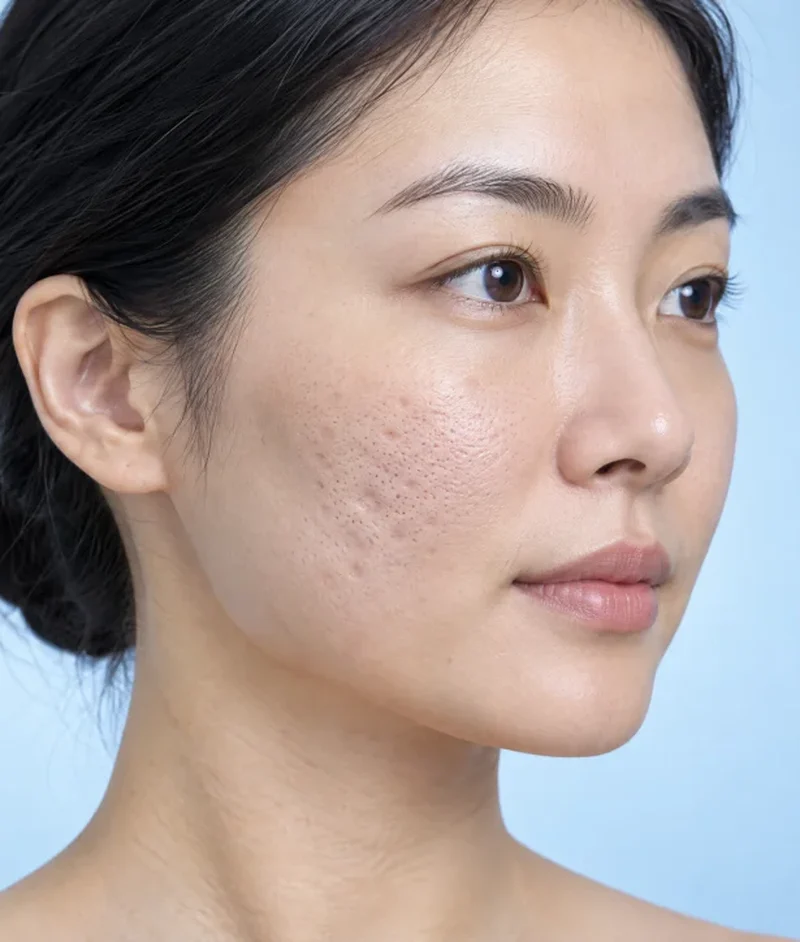 Before
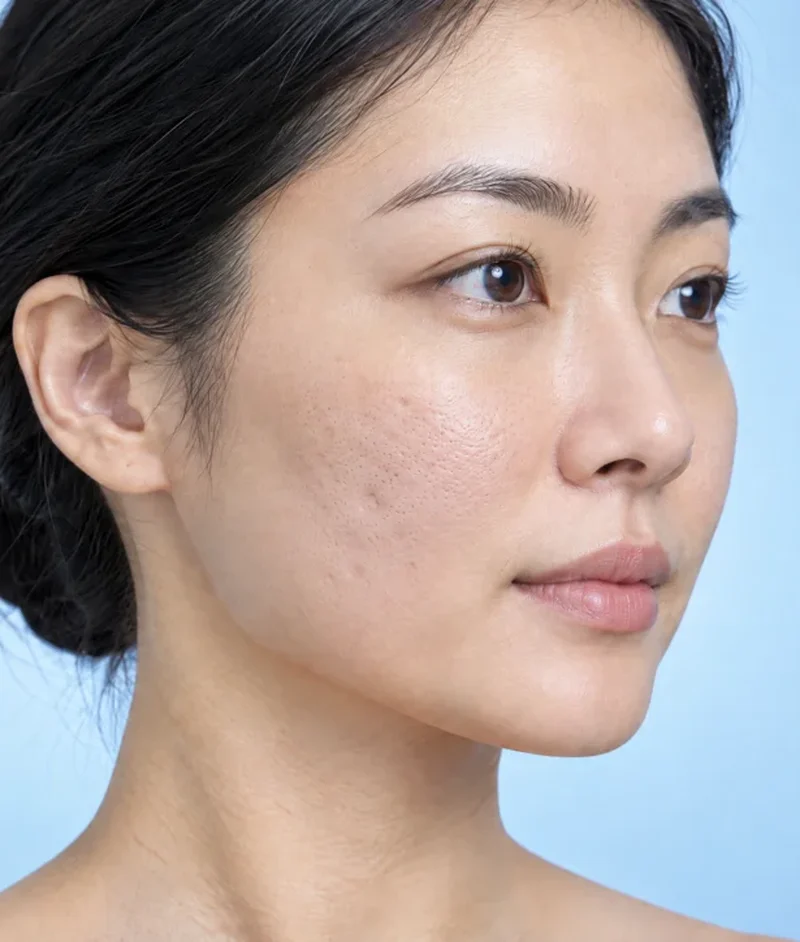 After 3 sessions
How long results last depends on what you are treating. Improvement in scars and texture comes from new collagen and tends to last relatively long. Oil reduction is short-lived. In a study of Korean patients with acne, sebum stayed below baseline for 8 weeks after a single session. Acne improvement, however, peaked at week 2, and most of it had returned to baseline by week 8. For deep, firm scars, Potenza alone has limits, and a combined plan is often discussed (see our acne scar treatment in Korea guide).
How Many Potenza Sessions, and How Often?
| Concern | Schedule in studies | Reported result |
|---|---|---|
| Acne scars | 3 sessions, one month apart | Scar scores fell by more than half; more sessions gave more improvement |
| Enlarged pores (22 patients) | 3 sessions, 1–3 months apart | Pore score 3.55 → 2.59 |
| Active acne | Median of 3 sessions | Lesion count 45 → 18.5; 94% improved |
The skin needs time to recover between sessions, so Potenza is not repeated at very short intervals. Dr. Park usually recommends three or more sessions about a month apart. After the first course, he reviews the skin and plans maintenance from there. With regular sessions, texture, tone and firmness can improve together, though how much varies from person to person.
Potenza Tips, the Pumping Tip and Korean Skin Boosters for Microneedling
What sets Potenza apart is that the tip changes with the concern. The main tips the manufacturer describes:
| Tip | How it works | Manufacturer's suggested use |
|---|---|---|
| Semi-insulated (S) | Only part of the needle is insulated; heat over a wider area | Melasma, redness, pores |
| Insulated (I) | Heat mainly at the needle end, less damage to the surface | Wrinkles, skin renewal |
| Non-insulated (N) | Heat along the whole needle | Melasma, redness, renewal, firmness |
| Pumping (CP) | Air pressure pushes applied product into the needle channels | Product delivery, scars |
| Single-pin | One needle, one spot at a time | Active acne, syringoma |
The pumping tip (sold outside Korea as the Fusion Tip) has 21 insulated needles (depth 0.5–2.5 mm) and two air chambers. The moment the needle channels open, it releases air so that product applied to the skin goes in deeper. This is the basis for combinations such as "Juvelook Potenza" or "exosome Potenza," where a Korean skin booster is delivered through the pumping tip. Compared with simply applying the product, more of it reaches the skin. Compared with injections, it tends to hurt less, so it can suit people who find injections difficult.
The evidence for these combinations is still limited. In a split-face study of 24 Asian patients, the side that received PLLA (a material in a similar family to the PDLLA in Juvelook) right after RF microneedling showed more improvement in texture and scar volume at six months. Studies of Juvelook or exosomes delivered through the pumping tip are still lacking. Experts also caution against putting products that are not approved for use inside the skin into needle channels, so always ask exactly which ingredient is being used. For more on the boosters themselves, see Rejuran vs Juvelook and our skin booster Korea guide.
Does Potenza Hurt?
Needles plus heat cause a prickling, hot sensation, so numbing cream is usually applied thoroughly before treatment starts. Average pain scores reported in studies:
| Study | Average pain score (out of 10) |
|---|---|
| Asian acne scars (3 sessions) | 5.6 |
| Enlarged pores (3 sessions) | 6.42 |
| Acne scar split-face comparison | RF microneedling 7.0; CO2 laser 5.5 |
With numbing cream, most people describe it as tolerable. It tends to feel stronger with deeper needles and higher energy, and over bony areas such as the forehead and jaw. If pain worries you, say so at the consultation.
Potenza Downtime vs Other RF Microneedling Downtime
| Reaction | Usual duration |
|---|---|
| Redness, warmth | Treatment day to a few days |
| Dot-like needle marks, thin crusts | A few days |
| Swelling | Usually a few days |
| Makeup | Usually skip for 2–3 days; from 1 day to 3–4 days or more depending on your skin |
Plan for about 2–3 days of downtime. This is in line with RF microneedling in general. A review of 85 microneedling studies found that the common reactions were redness, swelling and pain lasting up to about 7 days. Deeper needles and higher energy mean a slightly longer recovery, so leave a few days of margin before an important event. After treatment, sun protection and moisturizing matter.
Side Effects and When to Tell Us First
No treatment is free of side effects. These are the reactions reported with microneedle RF devices such as Potenza:
- Common: redness, swelling, stinging, itching; most settle within a few days.
- Acne flare: some people get a temporary breakout.
- Post-inflammatory pigmentation: the risk rises with darker skin and with sun exposure.
- Needle-pattern redness: on very sensitive skin or with poor aftercare, red marks in the needle pattern can appear briefly; they do not last long.
- Rare: infection, needle-pattern scarring that lasts, granuloma reactions.
Pigmentation deserves attention because Asian skin tends to develop it after laser treatments. A review of 35 studies on darker skin types (Fitzpatrick III–VI) found 7 reports of temporary pigmentation, 1 of long-lasting pigmentation and 1 lasting scar. The risk was low, but the quality of the studies was limited. If redness or brown patches persist, contact the clinic that treated you right away.
Tell us beforehand if you have inflammation or an infection such as herpes in the area, are pregnant or breastfeeding, have an implanted electronic device such as a pacemaker, have a metal allergy, form keloids easily, are taking or recently stopped isotretinoin, or recently had filler. These can change whether and how Potenza is done.
Potenza vs Morpheus8 vs CO2 Fraxel
| Potenza | CO2 fractional laser | Morpheus8, Secret, Scarlet | |
|---|---|---|---|
| Method | RF heat into the dermis through needles | Laser vaporizes tiny columns of skin | Same microneedle RF approach as Potenza |
| Surface damage | Lower | Higher | Lower |
| Scar improvement | Steady improvement | Slightly greater in studies | Depends on device and settings |
| Redness, pigmentation | Shorter, lower risk | Longer, higher risk | Lower |
A meta-analysis of 8 randomized trials (249 patients) found that CO2 fractional laser improved scars slightly more, but carried about a 4.4 times higher pigmentation risk and about 1.7 more days of redness. In a separate split-face trial, results three months after a single session were similar. The laser caused more redness, while RF microneedling hurt more. Our Fraxel laser for pores article covers the laser side in more detail.
On Potenza vs Morpheus8: Morpheus8 (InMode), Secret and Scarlet are all in the same microneedle RF family as Potenza. The needle type (insulated or non-insulated), depth, energy settings and the operator's experience shape the result more than the brand name. If your main goal is tightening the whole face with heat rather than resurfacing, that is a different category of treatment (see skin tightening in Korea).
Microneedling in Korea: What a Potenza Visit in Seoul Looks Like
Kondae PPEUM Clinic is directly connected to Konkuk Univ. Station Exit 1 in Seoul. A Potenza visit usually follows these steps:
- Consultation: your concern (pores, scars, texture, acne) decides the tip, depth and whether the pumping tip is used. This is also the time to mention medications, recent filler, pain sensitivity or any condition from the list above.
- Numbing: numbing cream is applied thoroughly before treatment.
- Treatment: the handpiece is passed over the planned area, delivering needles and RF heat.
- Afterward: expect redness and dot-like marks; plan on skipping makeup for 2–3 days, protecting your skin from the sun and moisturizing.
For travelers, the timing matters more than the treatment itself. Sessions are spaced about a month apart, so a single short trip usually covers one session, and a full course means returning or planning the rest of the course with your doctor. One session can change texture or oiliness for some people, but studies built results on repeated sessions, so set your expectations accordingly. Book your session early in the trip rather than the day before a flight or a big photo day, so the redness has time to settle. If this is your first time at a Korean clinic, our first-time Korean clinic guide covers booking and consultation basics.
Potenza Korea Price
Standing prices at Kondae PPEUM Clinic (tips are charged separately unless stated):
- First-visit Potenza trial (1 session, tip not included): KRW 59,000 — first-visit price
- Potenza, 1 session (tip not included): KRW 190,000
- Potenza Pumping, 1 session (tip not included): KRW 190,000
- Potenza 3 sessions + CryoCell 3 sessions (tip not included): KRW 500,000
- Potenza tip (N25): KRW 50,000
- Potenza pumping tip (CP25): KRW 60,000
Potenza events in Korea
Kondae PPEUM Clinic regularly updates its events and packages, including first-visit prices and bundles with other treatments. The prices above are standing prices. For the latest Potenza event prices and conditions, check the packages page.
See current events →Prices are subject to change. When comparing clinics, check the same five things: which tip is used (standard needle tip, pumping tip, single-pin tip); full face or one area, and how many shots; whether an ingredient is delivered through the pumping tip and what it is; whether the price is for one session or a course; and whether numbing and soothing care are included. Once these conditions match, the difference between clinics is often small.
FAQ — Potenza RF Microneedling in Korea
Q: What is Potenza microneedling, and how is it different from regular microneedling?
A: Potenza is RF microneedling. The needles not only make tiny channels but also release radiofrequency heat inside the dermis, creating small heated zones that the skin repairs by forming new collagen. Tips, depth (0.5–4.0 mm) and RF mode are adjusted to the concern.
Q: Does one Potenza session work?
A: Some people notice changes in texture or oiliness after one session, but most studies used three monthly sessions as one course, and improvement was greater with more sessions. Dr. Park usually recommends three or more sessions about a month apart.
Q: How long is Potenza downtime?
A: Usually about 2–3 days of redness, dot-like marks and mild swelling. Dr. Park recommends skipping makeup for 2–3 days; some people need only a day, others 3–4 days or more. Deeper, higher-energy settings take a little longer.
Q: Potenza vs Morpheus8: which is better?
A: Neither is simply better. Both are microneedle RF devices, and Dr. Park notes that needle type, depth and energy settings shape the result more than the device name. Choose based on your concern and the plan explained to you.
Q: Can I have Potenza in summer?
A: It can be done in any season, but heavy sun exposure while the skin is sensitive after treatment raises the risk of pigmentation, so use sun protection carefully.
Q: Can I have Potenza with active acne?
A: It is sometimes used to treat acne, including with a single-pin tip. Whether and how it is done depends on how inflamed the skin is and what medication you take, so this is checked at consultation first.
Q: Will Potenza remove my acne scars?
A: It makes shallow scars less noticeable rather than removing them. In one study of Asian patients, the largest group reported 26–50% improvement six months after three sessions. Deep, firm scars respond only partly to one treatment.

Related Before & After Cases and Guides
- Hollow Temples Treatment in Korea: Gouri & HILO WAVE Before and After
- Skin Booster Before and After Korea — Gouri + HILO WAVE Results
- Lip Filler Before and After Seoul — DR.BAQUO Results
- Cheek Filler Korea: Get Natural Volume in One Day
- Double Chin Treatment Korea: Seoul's Most Effective Fix
- Before & After gallery (members)
Sources
- Jeisys Medical. POTENZA product specifications (modes, frequencies, needle depth, tips). jeisys.com
- Cynosure. Potenza Physician Brochure — Fusion Tip. cynosure.com
- Xu Y et al. Microneedle Radiofrequency Induces Extracellular Matrix Remodeling Through Fibroblast Activation — A Histological Study in a Porcine Model. Lasers Surg Med, 2025. PubMed 40444432
- Vejjabhinanta V et al. The efficacy in treatment of facial atrophic acne scars in Asians with a fractional radiofrequency microneedle system. J Eur Acad Dermatol Venereol, 2014. PubMed 25158223
- Huang L et al. Efficiency and safety of microneedling fractional radiofrequency in the treatment of Chinese atrophic acne scars. J Cosmet Dermatol, 2023. PubMed 36217740
Show 9 more sources
- Huang Y et al. Efficacy and safety of fractional micro-needling radiofrequency for the treatment of enlarged pores on the cheeks of a Chinese cohort. Lasers Med Sci, 2024. PubMed 38609686
- Lee S et al. A Retrospective Analysis of the Clinical Response and Safety of Radiofrequency Microneedling Treatment in Managing Acne Vulgaris. Aesthet Surg J Open Forum, 2026. PubMed 42582510
- Lee KR et al. Assessment of treatment efficacy and sebosuppressive effect of fractional radiofrequency microneedle on acne vulgaris. Lasers Surg Med, 2013. PubMed 24249246
- Argobi Y et al. Fractional CO2 Laser Versus Micro Needling Radiofrequency for Post Acne Scarring — A Meta-Analysis of RCTs. J Cosmet Dermatol, 2026. PubMed 41821146
- Hendel K et al. Fractional CO2-laser versus microneedle radiofrequency for acne scars — A randomized, single treatment, split-face trial. Lasers Surg Med, 2023. PubMed 36934435
- Syder NC et al. Radiofrequency and Radiofrequency Microneedling in Skin of Color — A Review of Usage, Safety, and Efficacy. Dermatol Surg, 2023. PubMed 36826381
- Chu S et al. Safety Profile for Microneedling — A Systematic Review. Dermatol Surg, 2021. PubMed 34448760
- Kupwiwat R et al. Transdermal Delivery of Poly-L-Lactic Acid via Fractional Microneedle Radiofrequency for Atrophic Acne Scars — A Split-Face Randomized Study. Dermatol Ther (Heidelb), 2026. PubMed 41442012
- Ren K et al. Fractional microneedle radiofrequency treatment for enlarged facial pores — A real-world retrospective observational study on 75 patients. J Cosmet Dermatol, 2022. PubMed 36038248
This guide is general information and does not replace an in-person consultation. Results vary between individuals, and study results do not predict an individual outcome. Doctor's answers: Dr. Park Hwonham, Medical Director, Kondae PPEUM Clinic, reviewed October 2026.
DR.BAQUO | Hanlim Tower 2F, 229 Achasan-ro, Gwangjin-gu, Seoul | Konkuk University Station Exit 1 (Line 2) | Google Maps | LINE: @364kbfyj | global.drbaquo.com
VISIT
Kondae PPEUM Clinic
Dr. Park Hwonham (DR.BAQUO), Medical Director
- Address
- Hanlim Tower 2F, 229 Achasan-ro, Gwangjin-gu, Seoul
- Subway
- Line 2 Konkuk Univ. Station Exit 1 (directly connected)
- Hours
- Mon–Fri 10:00–20:30 · Sat 10:00–16:30 (KST)
 WhatsApp
 LINE

 WhatsApp
 LINE
 WeChat
 Instagram
 YouTube
 TikTok
 KakaoTalk

